
Rural Broadcasting Equipment Setup: Configuration and Maintenance Tips
Learn how to set up rural broadcasting equipment, including system configuration, speaker placement, power solutions, and maintenance tips for reliable public address communication in remote areas.
Becke Telcom
Introduction to Rural Broadcasting Systems
What Is Rural Broadcasting?
Rural broadcasting refers to the use of public address (PA) or IP-based audio systems to deliver announcements, alerts, and information across villages, agricultural areas, and remote communities.
These systems are widely used for public notifications, emergency warnings, community coordination, and educational broadcasting.
Challenges in Rural Deployment
Rural environments often present challenges such as limited power supply, long-distance coverage requirements, and harsh weather conditions.
Therefore, broadcasting equipment must be reliable, durable, and easy to maintain.
Effective rural broadcasting systems ensure that critical information reaches communities quickly, even in remote and infrastructure-limited areas.
System Configuration for Rural Broadcasting
Core Equipment Selection
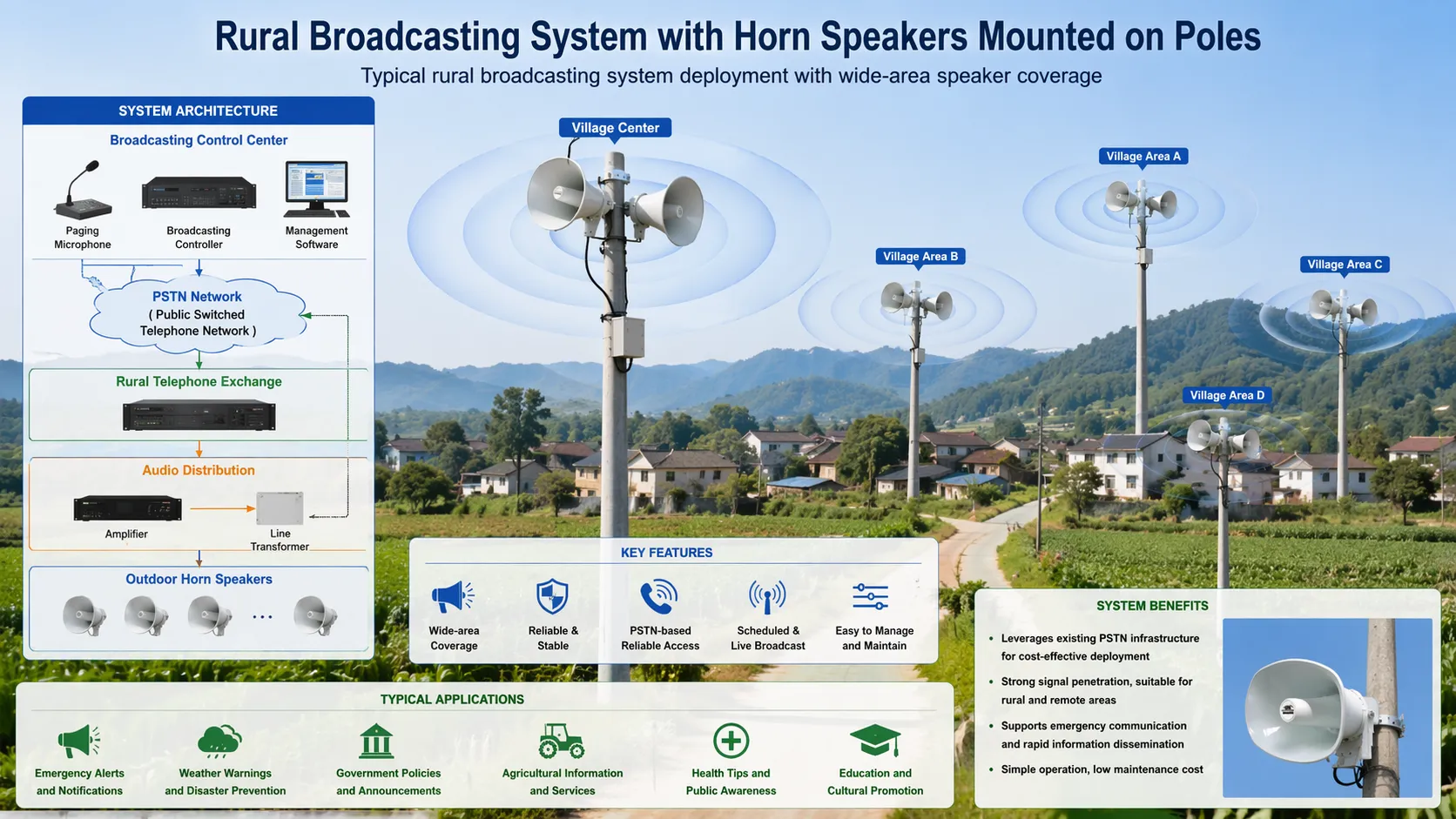
A typical rural broadcasting system includes microphones, amplifiers, loudspeakers (such as horn speakers), and a control unit or IP network device.
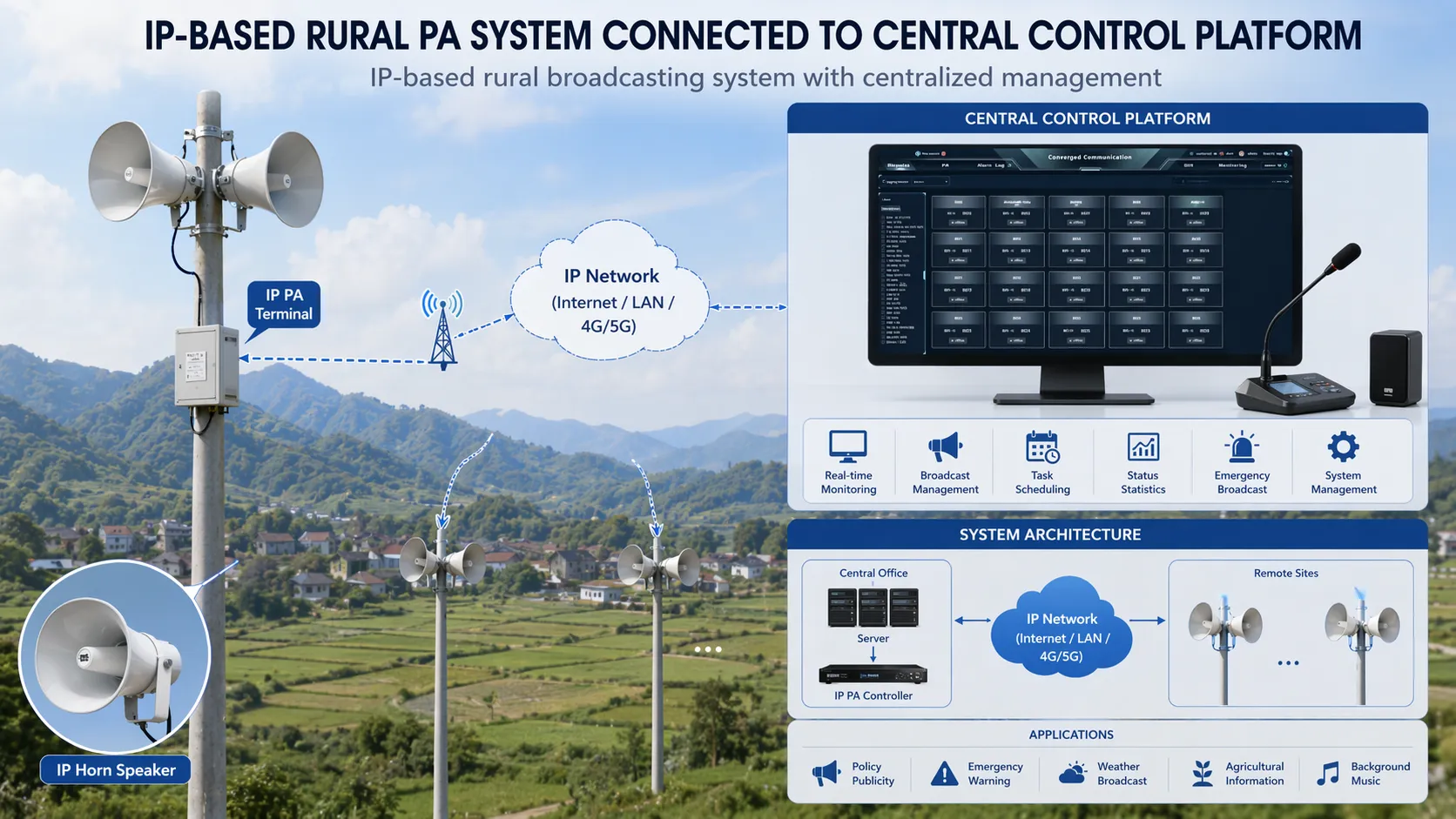
In modern deployments, SIP-enabled IP speakers and gateways are used to enable centralized control and remote management.
Speaker Placement and Coverage
Speakers should be strategically placed to ensure even sound distribution across the target area.
Elevated mounting positions and weatherproof horn speakers are commonly used for wide coverage.
Power Supply Solutions
Reliable power is critical in rural areas. Systems may use solar power, batteries, or hybrid power solutions to ensure continuous operation.
Backup power systems are recommended to prevent service interruptions.
Network and Connectivity
Depending on the environment, systems may use wired connections, wireless links, or mobile networks.
IP-based systems allow remote monitoring and integration with centralized communication platforms.
Typical rural broadcasting system deployment with wide-area speaker coverage
Key Features of Rural Broadcasting Equipment
Weather Resistance
Equipment must be designed to withstand rain, dust, heat, and humidity.
Outdoor-rated enclosures and industrial-grade components are essential.
Wide Coverage Capability
Rural broadcasting systems are designed to cover large geographic areas with minimal infrastructure.
High-power amplifiers and horn speakers are commonly used.
Remote Management
Modern systems support remote configuration and monitoring through IP networks.
This reduces the need for on-site maintenance.
Integration with Communication Systems
Rural broadcasting can be integrated with SIP, VoIP, and emergency communication systems.
Solutions from providers like Becke Telcom enable unified communication and centralized control.
IP-based rural broadcasting system with centralized management
Maintenance Tips for Rural Broadcasting Systems
Regular Equipment Inspection
Routine checks should be conducted to ensure that speakers, cables, and power systems are functioning properly.
Early detection of faults helps prevent system failure.
Cleaning and Environmental Protection
Dust and moisture can affect performance. Equipment should be cleaned regularly and properly sealed.
Protective enclosures can extend equipment lifespan.
Power System Maintenance
Batteries and solar panels should be inspected and maintained to ensure reliable power supply.
Backup systems should be tested periodically.
Software and Network Updates
For IP-based systems, firmware updates and network checks are essential.
This ensures system security and optimal performance.
Consistent maintenance is key to ensuring long-term reliability and performance of rural broadcasting systems.
Maintenance of rural broadcasting equipment in outdoor environments
Applications of Rural Broadcasting Systems
Public Announcements
Used for daily announcements, community updates, and local information dissemination.
Emergency Alerts
Critical for warning residents about natural disasters or emergencies.
Agricultural Communication
Broadcasting weather updates, farming guidance, and market information.
Education and Awareness
Used for public education campaigns and community awareness programs.
FAQ
What equipment is needed for rural broadcasting?
Typically microphones, amplifiers, speakers, and a control system.
Can rural broadcasting systems work without stable electricity?
Yes, with solar power and battery backup solutions.
Are IP-based systems suitable for rural areas?
Yes, especially when combined with wireless or mobile network connectivity.
We use cookie to improve your online experience. By continuing to browse this website, you agree to our use of cookie.
Cookies
This Cookie Policy explains how we use cookies and similar technologies when you access or use our website and related services. Please read this Policy together with our Terms and Conditions and Privacy Policy so that you understand how we collect, use, and protect information.
By continuing to access or use our Services, you acknowledge that cookies and similar technologies may be used as described in this Policy, subject to applicable law and your available choices.
Updates to This Cookie Policy
We may revise this Cookie Policy from time to time to reflect changes in legal requirements, technology, or our business practices. When we make updates, the revised version will be posted on this page and will become effective from the date of publication unless otherwise required by law.
Where required, we will provide additional notice or request your consent before applying material changes that affect your rights or choices.
What Are Cookies?
Cookies are small text files placed on your device when you visit a website or interact with certain online content. They help websites recognize your browser or device, remember your preferences, support essential functionality, and improve the overall user experience.
In this Cookie Policy, the term “cookies” also includes similar technologies such as pixels, tags, web beacons, and other tracking tools that perform comparable functions.
Why We Use Cookies
We use cookies to help our website function properly, remember user preferences, enhance website performance, understand how visitors interact with our pages, and support security, analytics, and marketing activities where permitted by law.
We use cookies to keep our website functional, secure, efficient, and more relevant to your browsing experience.
Categories of Cookies We Use
Strictly Necessary Cookies
These cookies are essential for the operation of the website and cannot be disabled in our systems where they are required to provide the service you request. They are typically set in response to actions such as setting privacy preferences, signing in, or submitting forms.
Without these cookies, certain parts of the website may not function correctly.
Functional Cookies
Functional cookies enable enhanced features and personalization, such as remembering your preferences, language settings, or previously selected options. These cookies may be set by us or by third-party providers whose services are integrated into our website.
If you disable these cookies, some services or features may not work as intended.
Performance and Analytics Cookies
These cookies help us understand how visitors use our website by collecting information such as traffic sources, page visits, navigation behavior, and general interaction patterns. In many cases, this information is aggregated and does not directly identify individual users.
We use this information to improve website performance, usability, and content relevance.
Targeting and Advertising Cookies
These cookies may be placed by our advertising or marketing partners to help deliver more relevant ads and measure the effectiveness of campaigns. They may use information about your browsing activity across different websites and services to build a profile of your interests.
These cookies generally do not store directly identifying personal information, but they may identify your browser or device.
First-Party and Third-Party Cookies
Some cookies are set directly by our website and are referred to as first-party cookies. Other cookies are set by third-party services, such as analytics providers, embedded content providers, or advertising partners, and are referred to as third-party cookies.
Third-party providers may use their own cookies in accordance with their own privacy and cookie policies.
Information Collected Through Cookies
Depending on the type of cookie used, the information collected may include browser type, device type, IP address, referring website, pages viewed, time spent on pages, clickstream behavior, and general usage patterns.
This information helps us maintain the website, improve performance, enhance security, and provide a better user experience.
Your Cookie Choices
You can control or disable cookies through your browser settings and, where available, through our cookie consent or preference management tools. Depending on your location, you may also have the right to accept or reject certain categories of cookies, especially those used for analytics, personalization, or advertising purposes.
Please note that blocking or deleting certain cookies may affect the availability, functionality, or performance of some parts of the website.
Restricting cookies may limit certain features and reduce the quality of your experience on the website.
Cookies in Mobile Applications
Where our mobile applications use cookie-like technologies, they are generally limited to those required for core functionality, security, and service delivery. Disabling these essential technologies may affect the normal operation of the application.
We do not use essential mobile application cookies to store unnecessary personal information.
How to Manage Cookies
Most web browsers allow you to manage cookies through browser settings. You can usually choose to block, delete, or receive alerts before cookies are stored. Because browser controls vary, please refer to your browser provider’s support documentation for details on how to manage cookie settings.
Contact Us
If you have any questions about this Cookie Policy or our use of cookies and similar technologies, please contact us at support@becke.cc .