touchpoint

In addition to terminal devices, all personnel, places, and things connected to the network should also be considered.

View Details

resource

Understand best practices, explore innovative solutions, and establish connections with other partners throughout the Baker community.

×

touchpoint

touchpoint

In addition to terminal devices, all personnel, places, and things connected to the network should also be considered.

Learn more

resource

resource

Understand best practices, explore innovative solutions, and establish connections with other partners throughout the Baker community.

Contact Us

Fire and rescue organizations operate in an environment where speed, clarity, and coordination directly affect life safety. A major structure fire, hazardous materials incident, highway rescue, mass casualty event, wildfire interface operation, or urban search and rescue deployment may involve multiple responding units, different communications channels, several command levels, and more than one agency within minutes. In these situations, fragmented systems create delays. The communications center may receive the call, but the field may not share the same operational picture. Incident commanders may be managing tactics on scene while the emergency operations center is still gathering information from different systems. Mutual aid partners may be responding, but not yet fully integrated into the same communications and dispatch workflow.

That is why an integrated fire and rescue command, control and communications solution should not be written as a simple dispatch platform or radio console project. In practical operation, it is a complete operational framework that connects emergency call intake, computer-aided dispatch, land mobile radio, broadband communication, GIS-based situational awareness, incident command support, emergency operations center coordination, and interagency information exchange into one organized response structure. The purpose is not only to move information faster, but to help the organization make better decisions from the first call to the last operational update.

A modern solution combines emergency communications center workflows, CAD dispatch logic, station alerting, radio and push-to-talk communications, field video and data sharing, incident command support tools, EOC conferencing, mapping, unit tracking, and cross-agency coordination. Instead of forcing fire and rescue teams to work through separate voice, data, and command systems, it builds a more connected pathway between the communications center, the command post, mobile responders, and executive coordination teams.

Why Fire and Rescue Agencies Need an Integrated Command, Control, and Communications Architecture

Emergency response now depends on more than voice dispatch alone

Traditional voice-based dispatch remains essential, but modern emergency operations demand much more than a call-taker, a dispatcher, and a radio channel. Fire and rescue agencies now manage multi-agency incidents, high data volumes, rapidly changing field conditions, and increased expectations for situational awareness. A response may begin with a voice call, but it often expands immediately into location intelligence, unit recommendations, status tracking, hazardous site information, pre-incident plans, field video, patient-related coordination, evacuation messaging, and command-level decision support.

When these capabilities sit in separate systems, important information travels too slowly. Dispatchers may have the incident record, but the incident commander may not have the same map view. The field may have radio traffic, but not the latest operational notes. Mutual aid units may be assigned, but not fully visible in the same incident workflow. The result is not necessarily system failure, but reduced operational clarity when clarity matters most.

Large incidents require a common operating picture across the center, the field, and leadership

Fire and rescue incidents often evolve in stages. Initial dispatch is only the first phase. A working fire may expand to multiple alarms. A technical rescue may require law enforcement, EMS, utilities, and public works support. A wildfire interface event may involve evacuation planning, road control, staging, and regional coordination. In each case, the incident ground needs strong on-scene command, while the emergency operations center or higher-level coordination function may need to support resource prioritization, public information, mutual aid, and strategic decision-making.

An integrated solution helps bridge these layers. The communications center can create and manage the event, field units can communicate and share status, the incident command structure can direct tactics, and the EOC can coordinate broader support using the same incident framework rather than disconnected updates.

The most effective fire and rescue communications systems do not stop at dispatch. They extend from call intake to on-scene command, from field communications to strategic coordination, and from individual unit status to a shared operational picture.

What Is an Integrated Fire and Rescue Command, Control and Communications Solution?

A practical system definition

An integrated fire and rescue command, control and communications solution is an operational platform designed to unify emergency call intake, incident creation, resource dispatch, field communications, incident command support, emergency operations center coordination, and interagency information exchange within one structured response workflow. It typically includes communications center call handling, computer-aided dispatch, radio dispatch, broadband push-to-talk, GIS-based mapping, unit tracking, event visualization, command collaboration, and interfaces for partner agencies and external systems.

The solution is suitable for municipal fire departments, regional fire and rescue services, airport rescue and firefighting units, industrial fire brigades, national rescue organizations, and combined public safety operations centers where multiple agencies or multiple response disciplines must work together during routine and high-consequence incidents.

How the solution works during a live incident

When an emergency call is received, the communications center creates the incident and validates the location, event type, and priority. CAD applies agency rules, recommends resources, and issues dispatch instructions. Station alerting, mobile devices, radio channels, and broadband applications can all be activated through the same event workflow. Responding units begin moving, while the center maintains visibility of assignments, status updates, and location context.

As the incident develops, the incident commander manages field tactics under the incident command structure, while the communications center continues to support radio traffic, status changes, additional resource requests, and data flow. If the situation expands, the EOC or coordination center can receive the same incident context, participate in conferencing, monitor field activity, support mutual aid and resource allocation, and maintain a broader common operating picture. In this way, the solution supports both tactical command and strategic coordination without forcing the organization to rebuild the incident picture at every level.

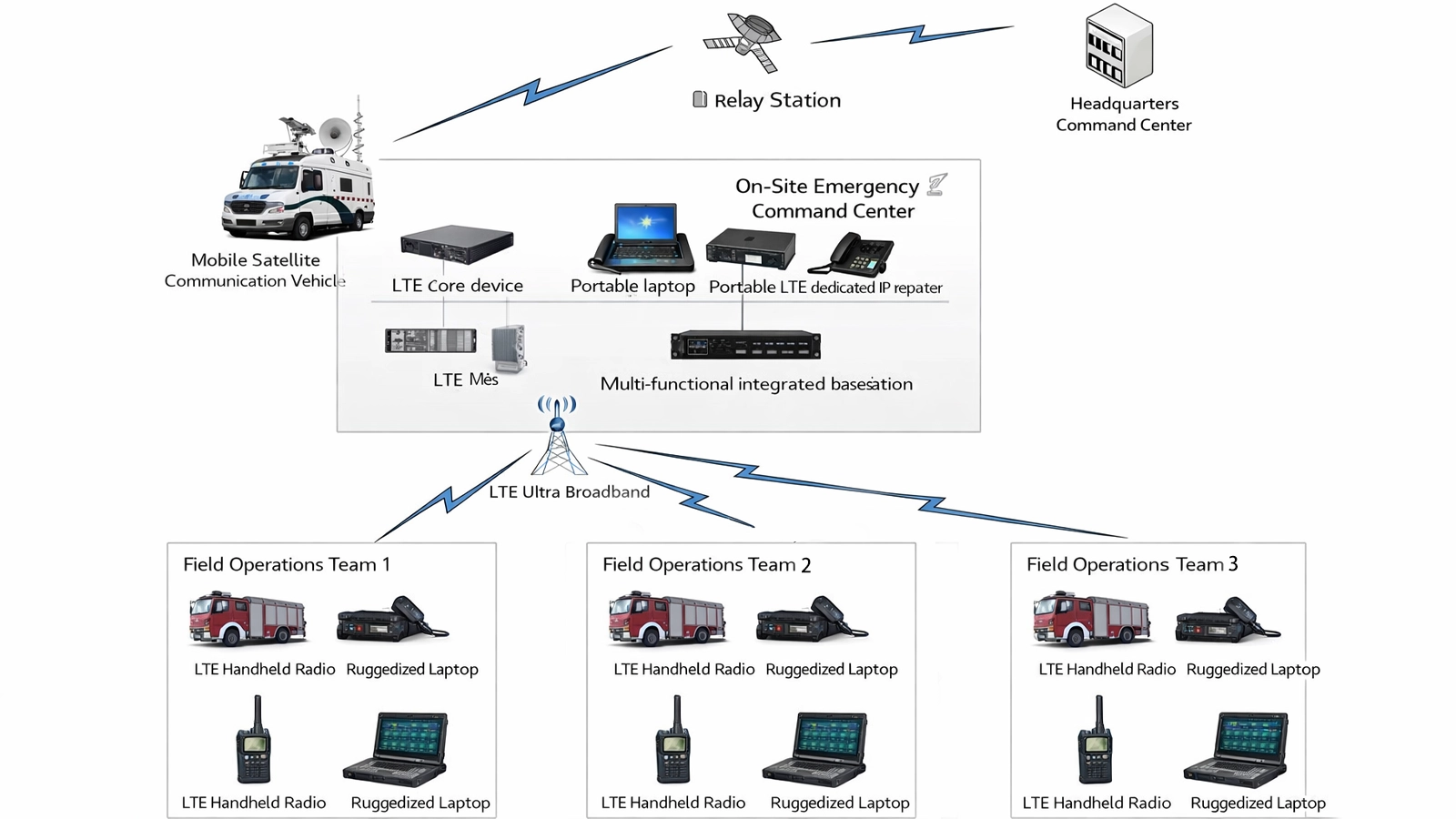
Integrated fire and rescue command, control and communications architecture linking emergency call intake, CAD dispatch, radio, broadband, GIS, command post, and emergency operations center
An integrated architecture connects the communications center, the incident ground, and command-level coordination through one operational workflow.

Core System Architecture

Emergency call intake and incident creation

The first layer of the solution is the point where the incident begins. Modern emergency call intake must be able to support more than traditional voice traffic. It must support accurate incident creation, location validation, caller information handling, and the intake of structured event data from multiple channels where relevant. The goal is to create a reliable incident record from the very beginning so that dispatch, field operations, and command coordination all start from the same event foundation.

This intake layer is also where call handling quality matters most. Clear event classification, rapid location confirmation, and immediate transfer of usable information into CAD help reduce delay and improve downstream response performance.

Computer-aided dispatch and resource coordination

CAD is the operational backbone of the communications center. It organizes incident data, recommends unit assignments, manages status transitions, supports response rules, and helps keep dispatchers aligned with agency procedures. In fire and rescue operations, CAD also helps the organization scale from a routine call to a major incident by maintaining a structured incident record as resources, alarms, and operational complexity increase.

Because CAD supports common incident workflows and resource coordination, it becomes one of the most important bridges between the communications center and field command. It is not only a dispatch tool. It is the record of operational movement through the life of the incident.

LMR, broadband, and push-to-talk communications

Field communication now depends on a combination of technologies rather than one network alone. Land mobile radio remains essential for mission-critical voice, especially in high-tempo and high-risk field environments. At the same time, broadband and push-to-talk services increasingly support data exchange, image sharing, GPS visibility, command messaging, and wider operational coordination beyond traditional voice radio alone.

An integrated solution should support these layers together rather than treating them as competing systems. Fire and rescue agencies need dependable tactical voice, but they also need richer operational awareness through mobile applications, mapping, media, and field data services. When radio and broadband are coordinated within one framework, the result is stronger resilience and better information flow.

GIS, location intelligence, and operational visualization

Location is at the center of fire and rescue decision-making. Dispatch needs to know where the incident is. Responders need the best route and access points. Incident command needs to understand the operational footprint. The EOC may need to view the incident in relation to infrastructure, risk zones, evacuations, hydrants, hazard sites, or mutual aid boundaries. GIS helps all of these roles work from the same spatial context.

When mapping, unit visibility, and incident overlays are integrated into the command workflow, agencies gain a more useful common operating picture. This becomes even more important during larger incidents where conditions, perimeters, and resource positions change quickly.

  • Emergency call intake and incident creation workflows
  • Computer-aided dispatch for response recommendation, resource assignment, and event tracking
  • Land mobile radio for primary tactical and dispatch voice communications
  • Broadband and push-to-talk tools for mobile data, media, and situational updates
  • GIS mapping, unit location, and spatial incident visualization
  • Station alerting, mobile notification, and responder status interfaces
  • Cross-agency information exchange and interoperability interfaces
  • Centralized event logging, monitoring, and operational oversight

Key Functional Capabilities

Multi-channel emergency call intake and incident creation

The first capability of the solution is to receive an incident quickly and turn it into structured operational information. This includes accurate call handling, event categorization, and the creation of an incident record that can support dispatch, field response, and command coordination without repeated re-entry or fragmented handoff. For agencies preparing for more data-rich emergency communications environments, this also supports stronger readiness for evolving multi-channel intake models.

From an operational standpoint, this reduces the time between initial report and effective dispatch. More importantly, it helps ensure that the rest of the organization begins working from the same verified incident foundation.

Computer-aided dispatch and dynamic resource assignment

Dispatching fire and rescue resources is no longer just a matter of calling out a station and waiting for a status update. The communications center needs to manage turnout, response recommendations, unit status, escalation, mutual aid, special resources, and ongoing event complexity. CAD makes this possible by applying response logic consistently and presenting dispatchers with a more controlled operational workflow.

This also improves scalability. A routine alarm, a multiple-casualty collision, and a regional wildfire event may all begin in the same communications center, but they will not remain the same kind of incident for long. A structured dispatch platform helps the agency grow the response without losing control of the event record.

Interoperable radio and broadband communication

Fire and rescue operations depend on reliable field communication under changing conditions. Tactical radio remains essential for command, crew safety, and rapid field coordination. But modern operations also benefit from broadband capabilities such as push-to-talk, live status sharing, GPS display, media exchange, and data-rich incident support. An integrated solution allows these tools to reinforce one another rather than forcing the agency to choose one path for all use cases.

This interoperability becomes especially valuable when incidents span jurisdictions, involve partner agencies, or require both voice-intensive tactical work and data-intensive strategic coordination.

Incident command system support for on-scene operations

The solution should support the command logic used on the incident ground, not work against it. In fire and rescue operations, that means aligning with the incident command system. Field command must be able to assign divisions and groups, request resources, manage staging, track tactical status, and maintain accountability while still receiving accurate support from the communications center.

When command support is integrated into the wider communications architecture, the incident commander does not have to rebuild the event picture independently. The command post can remain connected to dispatch, mapping, resource visibility, and supporting coordination functions throughout the incident.

Emergency operations center coordination and conferencing

As incidents grow in scale, complexity, or duration, the EOC or higher-level coordination function becomes increasingly important. The EOC is not there to replace the incident commander. Its role is to support the incident by coordinating information, resources, external stakeholders, mutual aid, and broader strategic actions. A strong solution should therefore support structured conferencing, common incident visibility, and controlled data sharing between the field, the communications center, and the EOC.

This is particularly valuable in regional disasters, major fires, prolonged rescue operations, and incidents that require coordination with hospitals, utilities, transportation agencies, law enforcement, or public information functions.

GIS-based situational awareness and unit visibility

Situational awareness improves when field units, command staff, and support centers are all looking at compatible information. GIS-based visualization helps agencies understand access routes, response coverage, hydrants, hazards, evacuation areas, mutual aid boundaries, and current unit distribution. When combined with field status and incident overlays, this gives both dispatchers and commanders a clearer and more actionable operating picture.

This capability also supports after-action review, pre-incident planning, and resilience across the wider service area because the organization can analyze not only what happened, but how geography affected the response.

  1. An emergency report enters the communications center and becomes a structured incident record.
  2. CAD applies response logic and dispatches the appropriate fire and rescue resources.
  3. Stations, mobile units, radio channels, and digital responder tools receive the dispatch information.
  4. The incident commander manages tactical operations while staying linked to the wider event workflow.
  5. The communications center continues status management, resource expansion, and interoperability support.
  6. If the event escalates, the EOC joins the coordination process through conferencing, mapping, and strategic oversight.
  7. All key actions, status changes, and incident updates remain visible within one integrated operational framework.

The purpose of integrated command, control, and communications is not simply to connect technologies. It is to connect decisions, resources, and responders through one coherent incident workflow.

Incident Command and Emergency Operations Center Coordination

Supporting the incident commander on the ground

The incident command post is where tactical decisions are made, but effective command depends on timely and reliable support from outside the immediate scene. Resource requests, mutual aid activation, personnel accountability, route updates, perimeter information, and interagency communication often depend on systems and roles beyond the command post itself. A strong command and communications solution helps maintain that support without overloading the field commander with disconnected data channels.

By linking dispatch, communications, mapping, and coordination tools to field command, the agency supports a cleaner tactical workflow and improves the speed at which command decisions can be translated into action.

EOC coordination for strategic support and resource management

When incidents expand beyond routine tactical control, leadership often needs a higher coordination layer that can focus on consequences beyond the immediate fireground. This may include regional resource distribution, continuity of operations, public information, evacuation coordination, medical surge considerations, utility coordination, or long-duration support planning. The EOC provides that strategic function.

An integrated solution should therefore allow the EOC to work from the same incident context as the communications center and the field. This avoids duplicated event creation, conflicting information trails, and fragmented situational awareness.

Emergency conferencing and multi-agency collaboration

Complex incidents require more than one voice and more than one command perspective. A large fire may require municipal leadership, mutual aid agencies, public works, law enforcement, utility operators, and hospital coordination. Structured conferencing helps align these stakeholders without reducing the authority of the incident commander or bypassing the communications center.

In practical terms, conferencing helps agencies share the same operational understanding, resolve interagency questions faster, and support a more organized response across technical, tactical, and strategic layers.

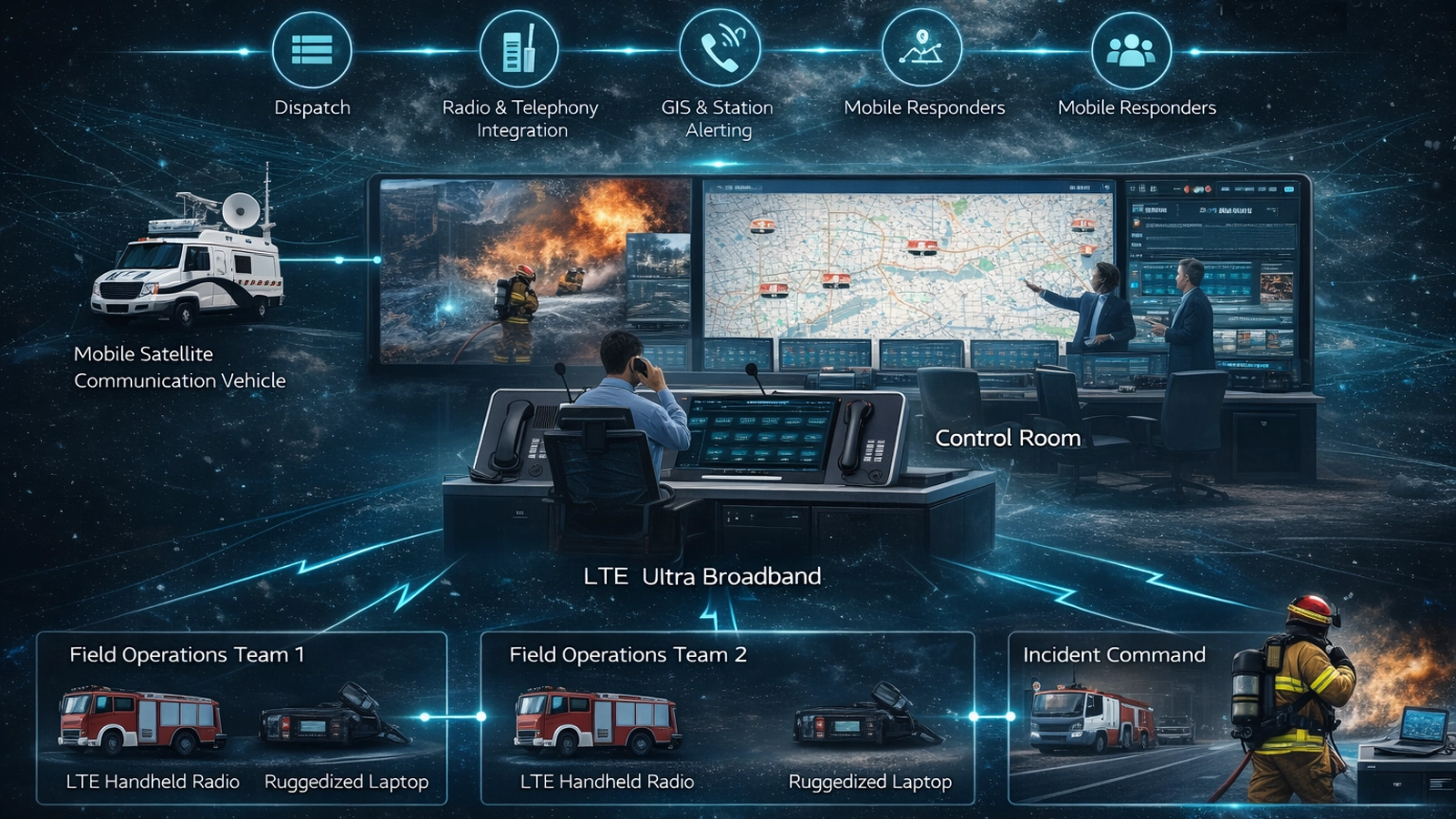
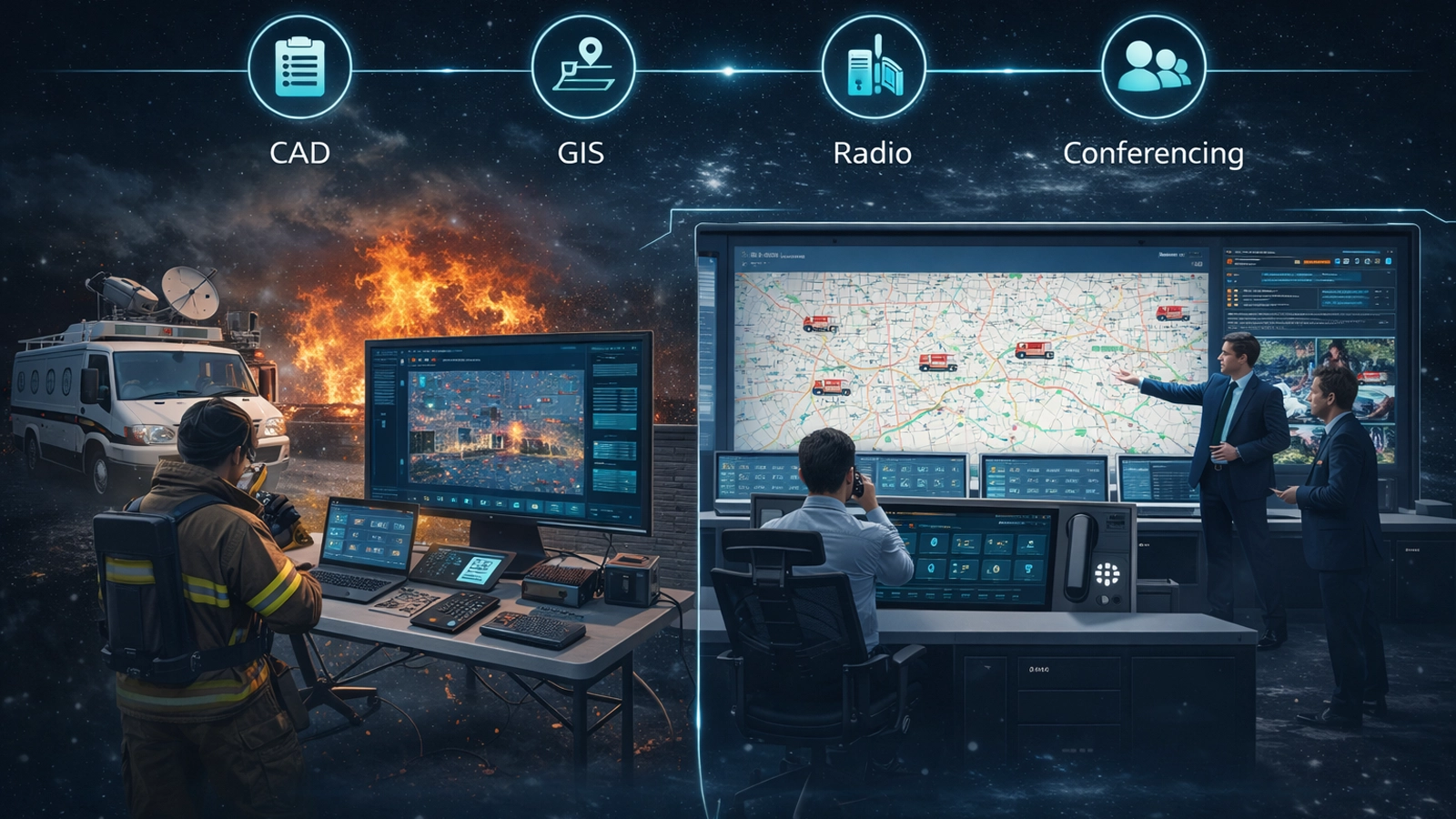
Fire and rescue incident command post and emergency operations center coordination with CAD, GIS, radio, conferencing, and shared situational awareness
Command post and EOC coordination work best when they share the same incident context, communications pathways, and operational visibility.

Interoperability with Radio, Broadband, CAD, and External Systems

Interoperability is now a core operational requirement

Fire and rescue agencies rarely operate alone. Even routine incidents may involve EMS, law enforcement, public works, or utility coordination. Larger events can add mutual aid, regional assets, airport or industrial response teams, and emergency management structures. A command, control, and communications solution must therefore be designed for interoperability rather than assuming a closed single-agency environment.

This includes interoperability in communications, incident data, resource management, and location sharing. The more seamlessly systems exchange usable information, the more effectively agencies can operate as one incident organization when needed.

CAD and data exchange strengthen mutual aid and unified response

Mutual aid becomes easier to manage when incident records, status logic, and response workflows are not trapped in one local system. Structured data exchange helps partner agencies receive usable incident information, update unit status more consistently, and support unified command more effectively. This matters not only in regional disasters, but also in everyday cross-boundary support where speed and accuracy still matter.

For agencies planning long-term resilience, stronger interoperability also supports future readiness as emergency communications continue to evolve toward richer data and multi-system coordination.

Becke Telcom integration perspective

For organizations seeking a more unified operational architecture, Becke Telcom can support integrated command, control, and communications environments that connect emergency call handling, CAD-related workflows, radio and broadband communications, GIS visibility, conferencing, and coordination functions into one practical platform approach. This helps fire and rescue agencies strengthen both day-to-day dispatch performance and major-incident coordination without relying on disconnected tools.

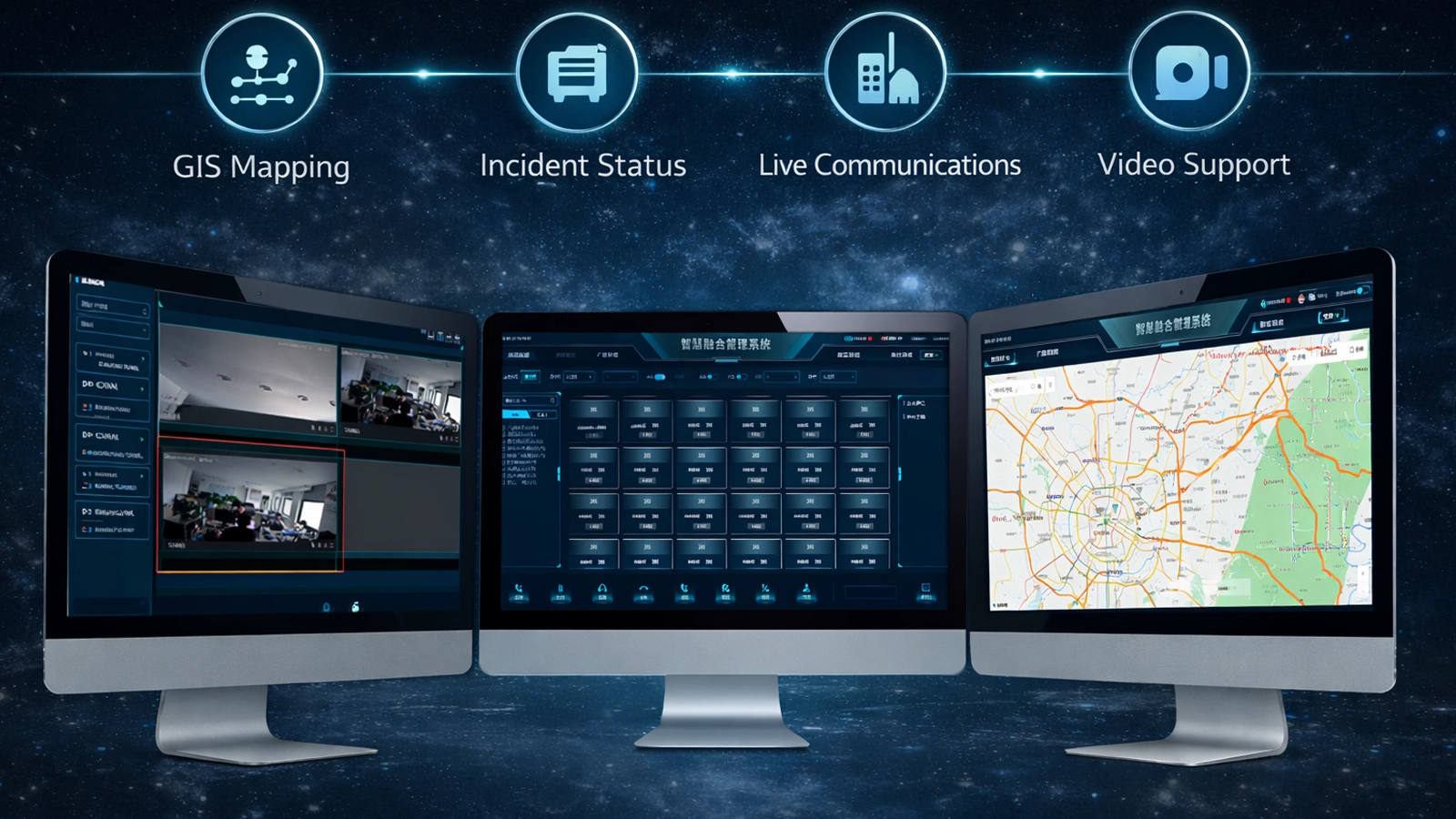
Integrated fire and rescue interoperability environment with land mobile radio, broadband push-to-talk, GIS mapping, CAD, and mutual aid coordination
Interoperability across radio, broadband, CAD, and GIS helps agencies maintain a stronger common operating picture during multi-agency incidents.

Typical Application Scenarios

Municipal fire and rescue agencies

City and regional agencies benefit from integrated dispatch, station alerting, mobile coordination, and command support because they routinely handle high call volumes, mixed incident types, and mutual aid dependencies. A more connected architecture improves both routine response and surge management during larger events.

Airport, industrial, and special-risk fire services

These environments often require stronger interoperability, richer site mapping, and faster coordination with facility operators and external responders. An integrated solution helps connect incident data, command communication, and specialized response workflows more effectively.

Wildfire interface and large-area incident response

Landscape incidents, evacuation support, and geographically distributed operations depend heavily on GIS, multi-channel communications, field visibility, and strategic coordination between field command and regional support structures. These are exactly the conditions where integrated command and communications become most valuable.

Multi-agency emergency operations centers

Jurisdictions that operate shared or coordinated EOC functions benefit from a solution that supports structured conferencing, common incident visibility, and cross-agency data flow. This helps maintain stronger coordination during prolonged, high-impact, or regionally significant emergencies.

  • Municipal and regional fire communications centers
  • Integrated fire and rescue headquarters
  • Airport and transport-related rescue operations
  • Industrial and campus emergency response environments
  • Wildfire and large-area incident management structures
  • Regional emergency operations centers and coordination hubs
  • Multi-agency public safety command environments
  • Special events and temporary unified command deployments

Key Benefits of the Solution

Faster incident handling from intake to field action

The first benefit is speed, but not only in dispatch. The greater value comes from reducing friction across the whole incident lifecycle. Call intake, CAD, station alerting, unit coordination, field command, and strategic support all work more smoothly when they are connected through one operational logic.

This helps agencies move from alarm to action with less rework, less confusion, and stronger incident continuity.

Stronger common operating picture across all response layers

An integrated solution improves situational awareness because dispatchers, commanders, and coordinating agencies no longer depend on disconnected fragments of the same incident. With shared visibility into event status, resources, mapping, communications, and escalation pathways, the organization is better equipped to manage both tactical and strategic demands.

Better interoperability, resilience, and long-term scalability

Because the architecture supports multiple communications methods, structured coordination, and cross-system integration, it is more resilient than a single-channel or single-console approach. It also gives the agency a better foundation for future modernization, mutual aid growth, and higher expectations around incident data and field visibility.

  • Faster incident creation, dispatch, and command support
  • More effective coordination between ECC, field command, and EOC functions
  • Better interoperability across radio, broadband, GIS, and CAD-related workflows
  • Improved situational awareness through shared mapping and unit visibility
  • Stronger support for unified command and multi-agency response
  • More resilient communications across routine and large-scale incidents
  • Cleaner event traceability and operational review
  • A stronger modernization path for fire and rescue communications architecture

Conclusion

An integrated fire and rescue command, control and communications solution should be understood as a complete operational framework rather than a single dispatch or communications product. Its purpose is to connect emergency call intake, CAD, field communications, incident command, EOC coordination, and situational awareness into one structure that helps agencies respond faster and manage incidents more effectively.

By aligning the communications center, the incident ground, and the strategic coordination layer through interoperable communications, GIS-based visibility, structured incident workflows, and command support functions, fire and rescue organizations can build a more resilient and more capable emergency response environment. The result is not only better communications, but better operational control from the first report to the final coordination decision.

FAQ

What does an integrated fire and rescue command, control and communications solution include?

It typically includes emergency call intake, incident creation, computer-aided dispatch, radio and broadband communications, GIS-based situational awareness, incident command support, emergency operations center coordination, and interoperability with partner systems.

Why is CAD important in this type of solution?

CAD provides the structured workflow that helps communications centers classify incidents, recommend resources, dispatch units, manage status changes, and maintain an operational incident record throughout the event lifecycle.

Why should radio and broadband both be part of the architecture?

Radio remains essential for mission-critical tactical voice, while broadband can support push-to-talk, media exchange, GPS, mapping, and richer data services. Together they create a stronger and more flexible operational communications environment.

How does the solution support the incident command system?

It supports ICS by helping field command stay connected to dispatch, resource coordination, situational awareness, and partner communications without forcing tactical leaders to work through disconnected systems.

What is the role of the emergency operations center in this solution?

The EOC supports incident management by coordinating information, resources, external stakeholders, mutual aid, and strategic actions beyond the immediate tactical scene, while remaining aligned with the same incident context.

Which organizations benefit most from this kind of solution?

Municipal fire departments, regional fire and rescue services, airport rescue units, industrial emergency teams, emergency operations centers, and multi-agency public safety organizations can all benefit from a more integrated command and communications architecture.

Professional industrial communication manufacturer, providing high reliability communication guarantee!
Cooperation Consultation
customer service Phone
We use cookie to improve your online experience. By continuing to browse this website, you agree to our use of cookie.

Cookies

This Cookie Policy explains how we use cookies and similar technologies when you access or use our website and related services. Please read this Policy together with our Terms and Conditions and Privacy Policy so that you understand how we collect, use, and protect information.

By continuing to access or use our Services, you acknowledge that cookies and similar technologies may be used as described in this Policy, subject to applicable law and your available choices.

Updates to This Cookie Policy

We may revise this Cookie Policy from time to time to reflect changes in legal requirements, technology, or our business practices. When we make updates, the revised version will be posted on this page and will become effective from the date of publication unless otherwise required by law.

Where required, we will provide additional notice or request your consent before applying material changes that affect your rights or choices.

What Are Cookies?

Cookies are small text files placed on your device when you visit a website or interact with certain online content. They help websites recognize your browser or device, remember your preferences, support essential functionality, and improve the overall user experience.

In this Cookie Policy, the term “cookies” also includes similar technologies such as pixels, tags, web beacons, and other tracking tools that perform comparable functions.

Why We Use Cookies

We use cookies to help our website function properly, remember user preferences, enhance website performance, understand how visitors interact with our pages, and support security, analytics, and marketing activities where permitted by law.

We use cookies to keep our website functional, secure, efficient, and more relevant to your browsing experience.

Categories of Cookies We Use

Strictly Necessary Cookies

These cookies are essential for the operation of the website and cannot be disabled in our systems where they are required to provide the service you request. They are typically set in response to actions such as setting privacy preferences, signing in, or submitting forms.

Without these cookies, certain parts of the website may not function correctly.

Functional Cookies

Functional cookies enable enhanced features and personalization, such as remembering your preferences, language settings, or previously selected options. These cookies may be set by us or by third-party providers whose services are integrated into our website.

If you disable these cookies, some services or features may not work as intended.

Performance and Analytics Cookies

These cookies help us understand how visitors use our website by collecting information such as traffic sources, page visits, navigation behavior, and general interaction patterns. In many cases, this information is aggregated and does not directly identify individual users.

We use this information to improve website performance, usability, and content relevance.

Targeting and Advertising Cookies

These cookies may be placed by our advertising or marketing partners to help deliver more relevant ads and measure the effectiveness of campaigns. They may use information about your browsing activity across different websites and services to build a profile of your interests.

These cookies generally do not store directly identifying personal information, but they may identify your browser or device.

First-Party and Third-Party Cookies

Some cookies are set directly by our website and are referred to as first-party cookies. Other cookies are set by third-party services, such as analytics providers, embedded content providers, or advertising partners, and are referred to as third-party cookies.

Third-party providers may use their own cookies in accordance with their own privacy and cookie policies.

Information Collected Through Cookies

Depending on the type of cookie used, the information collected may include browser type, device type, IP address, referring website, pages viewed, time spent on pages, clickstream behavior, and general usage patterns.

This information helps us maintain the website, improve performance, enhance security, and provide a better user experience.

Your Cookie Choices

You can control or disable cookies through your browser settings and, where available, through our cookie consent or preference management tools. Depending on your location, you may also have the right to accept or reject certain categories of cookies, especially those used for analytics, personalization, or advertising purposes.

Please note that blocking or deleting certain cookies may affect the availability, functionality, or performance of some parts of the website.

Restricting cookies may limit certain features and reduce the quality of your experience on the website.

Cookies in Mobile Applications

Where our mobile applications use cookie-like technologies, they are generally limited to those required for core functionality, security, and service delivery. Disabling these essential technologies may affect the normal operation of the application.

We do not use essential mobile application cookies to store unnecessary personal information.

How to Manage Cookies

Most web browsers allow you to manage cookies through browser settings. You can usually choose to block, delete, or receive alerts before cookies are stored. Because browser controls vary, please refer to your browser provider’s support documentation for details on how to manage cookie settings.

Contact Us

If you have any questions about this Cookie Policy or our use of cookies and similar technologies, please contact us at support@becke.cc .