
touchpoint

In addition to terminal devices, all personnel, places, and things connected to the network should also be considered.

View Details

resource

Understand best practices, explore innovative solutions, and establish connections with other partners throughout the Baker community.

×

touchpoint

touchpoint

In addition to terminal devices, all personnel, places, and things connected to the network should also be considered.

Learn more

resource

resource

Understand best practices, explore innovative solutions, and establish connections with other partners throughout the Baker community.

Contact Us
IndustryInsights
2026-04-16 11:33:08
Open Source SIP Server Comparison: Features, Performance, and Scalability
Open source SIP server comparison covering Kamailio, OpenSIPS, Asterisk, and FreeSWITCH across features, performance, scalability, deployment roles, and practical selection guidance for SIP and VoIP architectures.

Becke Telcom

Open Source SIP Server Comparison: Features, Performance, and Scalability

Open source SIP servers are often grouped together as if they solve the same problem in the same way. In practice, they occupy very different positions in a real-time communications architecture. Some are optimized for SIP signaling, registration, routing, and edge policy control. Others are designed to deliver PBX logic, media services, conferencing, IVR, and programmable communications workflows. That is why a useful comparison cannot stop at feature lists alone. It must also examine the architectural role of each platform, the type of workload it handles best, and the way it scales under production conditions.

Among the most widely discussed platforms, Kamailio, OpenSIPS, Asterisk, and FreeSWITCH are all important, but they are not interchangeable. Kamailio and OpenSIPS are commonly selected when high-performance SIP routing, registration, and signaling-layer policy control are required. Asterisk is widely used where telephony applications, PBX services, IVR, call queues, and business call flows matter most. FreeSWITCH is frequently chosen for highly programmable media handling, conferencing, and event-driven communications logic. Comparing them fairly means comparing them by role, workload profile, and deployment strategy rather than by brand recognition alone.

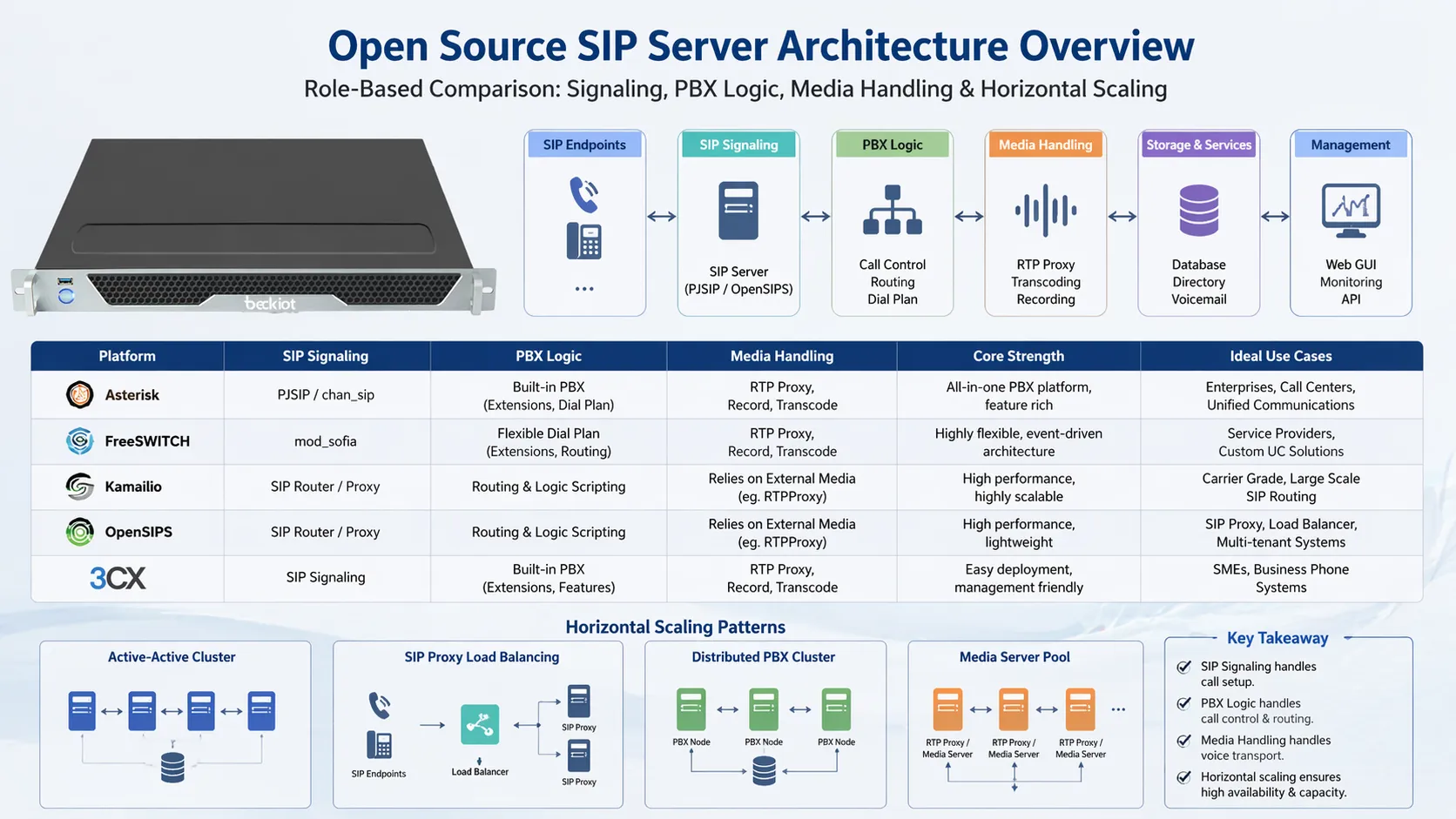
Architectural comparison of open source SIP server roles including SIP signaling, PBX logic, media handling, and horizontal scaling patterns
Open source SIP platforms are best understood by architectural role rather than by a single generic category.

Why Open Source SIP Server Comparison Matters

In many projects, the first design mistake happens before deployment begins. Teams ask which open source SIP server is the best, when the better question is which platform is best for a specific layer of the system. A wholesale SIP routing edge, a hosted multi-tenant registration service, a business PBX, a conferencing core, and an application-driven communications platform do not place identical demands on the software underneath them. A platform that performs extremely well as a SIP proxy may not be the strongest choice for a media-heavy conferencing deployment, while a PBX-oriented system may not be the lightest or most efficient option for large-scale signaling ingress.

This distinction becomes even more important as systems grow. Small deployments can often tolerate a platform doing many jobs at once. Larger deployments usually benefit from separation of concerns. SIP signaling, authentication, registration, topology control, and load distribution may sit at the edge, while application servers and media platforms operate behind them. When teams understand this layered approach early, they make better design decisions, avoid unrealistic performance expectations, and build systems that are easier to scale and maintain.

The most practical open source SIP comparison is not “Which server wins?” but “Which component belongs in which part of the architecture?”

What Counts as an Open Source SIP Server

SIP signaling platforms

Some open source SIP platforms are primarily designed to process signaling efficiently. Their strengths usually include registration, routing, policy enforcement, load balancing, SIP normalization, and edge behavior. In this category, Kamailio and OpenSIPS are often the most relevant names. They are especially useful when a deployment needs to manage large numbers of registrations, distribute SIP traffic across downstream services, apply custom routing logic, or enforce policy at the edge of a VoIP environment.

These platforms are typically chosen because they are highly scriptable and well suited to horizontal scaling strategies. Rather than embedding all business logic and media functions into a single node, they often act as the front-end signaling layer of a larger communications environment. In that role, they can shield downstream PBX or media systems, normalize traffic from multiple providers or device types, and help operators build a cleaner separation between ingress signaling and service execution.

PBX and communications application platforms

Another category includes platforms that are used to build telephony applications and business communications systems. Asterisk is the clearest example in this group. It is not only a SIP-speaking server, but also a communications framework that powers IP PBX systems, VoIP gateways, conference services, queue logic, voicemail, IVR, and custom call control. For organizations focused on office telephony, branch systems, contact-center style call handling, and programmable voice workflows, this kind of platform is often more relevant than a pure signaling router.

The tradeoff is straightforward. Asterisk can provide richer telephony features and application behavior within one environment, but that convenience also means it may take on more call-state and media-related responsibility than a pure SIP proxy. For many enterprise and SMB deployments, that is exactly the right decision. For very large signaling-heavy systems, it is often more efficient to let Asterisk concentrate on PBX and service logic while another platform handles front-end SIP distribution.

Media-centric communications engines

Some open source communications platforms are especially attractive when deep media control is a central requirement. FreeSWITCH fits this category well. It is widely appreciated for modularity, event-driven integration patterns, flexible conferencing behavior, and the ability to support complex real-time communications applications. In environments where media orchestration, conference control, custom application logic, and external integration are more important than acting as the lightest possible SIP proxy, FreeSWITCH becomes a strong candidate.

This does not mean FreeSWITCH is limited to conferencing. It can support many broader communication use cases. The important point is that teams often choose it when they want a programmable telecom engine with strong media and application behavior, rather than a platform whose primary value is handling massive front-end SIP signaling loads as efficiently as possible.

Feature Comparison Across Leading Platforms

A direct comparison becomes easier when the platforms are judged by what they are designed to do. The table below is intentionally architectural rather than marketing-driven.

PlatformPrimary roleCore strengthsTypical limitationsBest-fit environments
KamailioSIP proxy, registrar, routing and dispatch layerHigh-performance signaling, flexible routing script logic, dispatcher-based load balancing, scalable edge controlNot usually the first choice for full PBX feature delivery or media-heavy services by itselfCarrier edge, SIP trunk aggregation, large registration platforms, front-end routing for downstream services
OpenSIPSCarrier-grade SIP signaling server with clustering focusHigh-throughput signaling, modular routing logic, clustering options, scalable SIP servicesLike Kamailio, it is usually strongest as signaling infrastructure rather than as an all-in-one PBX/media platformLarge SIP platforms, distributed signaling, service-provider scenarios, clustered routing and registration
AsteriskCommunications application framework and PBX engineDialplan logic, IVR, queues, voicemail, PBX services, business telephony, custom application developmentNot typically the lightest option for very large front-end SIP distribution when compared with proxy-focused platformsEnterprise PBX, SMB telephony, call workflow applications, contact-center style services
FreeSWITCHModular real-time communications and media engineConference services, media control, modular expansion, event-driven integration, programmable telecom workflowsMay introduce more architectural complexity than a simple PBX deployment needsConference platforms, media-intensive services, programmable telecom applications, custom RTC environments

Routing, registration, and edge control

Kamailio and OpenSIPS stand out most clearly when the conversation turns to routing, registration, and edge policy enforcement. These are the kinds of platforms operators use when they need to terminate SIP signaling at the edge, authenticate requests, maintain user location data, control traffic flow, distribute load, and steer requests toward downstream application or media systems. In large systems, that front-end role can be more important than any individual PBX feature because it determines how efficiently the environment absorbs load, isolates failures, and applies routing rules.

In practical terms, this means they are often selected for large registration farms, SIP interconnection environments, SBC-adjacent signaling layers, or multi-node service platforms where signaling needs to be separated from call application logic. Their scripts and modules allow for a high degree of policy customization, which is one reason they remain popular in service-provider and platform-style deployments.

Call control, telephony services, and business logic

Asterisk excels when the required feature set looks like a telephony system rather than a signaling edge. Auto attendants, ring groups, call queues, voicemail, dialplan-driven routing, extension behavior, call recording, and integration into internal business calling patterns are all areas where Asterisk remains highly relevant. It gives teams a mature framework for building working communication services quickly, especially when the goal is not only to pass SIP messages but to shape the user-facing telephony experience.

FreeSWITCH can also support rich call services, but it is often chosen when a project demands stronger media programmability, complex call orchestration, or conference-centric behavior. In other words, both Asterisk and FreeSWITCH can go beyond basic SIP handling, but they are often selected for somewhat different reasons: Asterisk for PBX and application workflow familiarity, FreeSWITCH for media-centric programmability and event-driven control.

Developer extensibility and integration

All four platforms are extensible, but they expose that extensibility differently. Kamailio and OpenSIPS are typically extended through routing scripts, modules, and integrations with external systems such as databases, billing engines, application servers, and provisioning systems. Their value lies in allowing operators to shape signaling behavior very precisely. For architects who need custom SIP logic, traffic steering, tenant-aware routing, or front-end interoperability control, that flexibility is often the deciding factor.

Asterisk and FreeSWITCH, on the other hand, are frequently evaluated by their developer interfaces and application-building patterns. Asterisk’s REST-oriented development model and FreeSWITCH’s event socket approach both appeal to teams building custom communication services that need tight external control. The result is that developer experience is not a single comparison point across these projects; it depends on whether the team is primarily extending signaling behavior or building application-level call and media services.

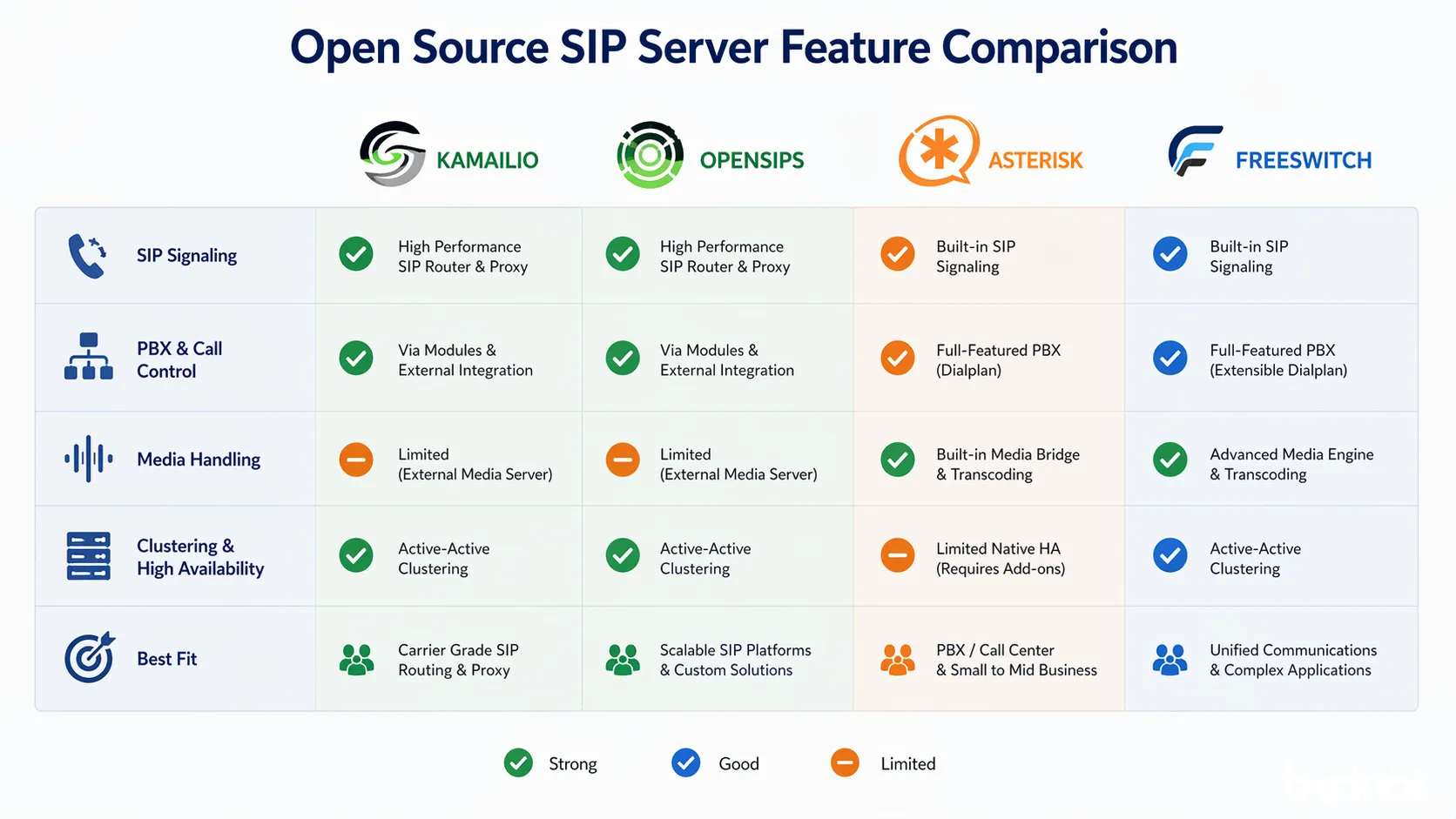
Feature comparison visual for Kamailio OpenSIPS Asterisk and FreeSWITCH showing signaling, PBX, media, and clustering focus
Feature comparisons are most useful when signaling, PBX, and media capabilities are separated instead of mixed together.

Performance Considerations in Real Deployments

Signaling throughput versus media workload

Performance comparisons are often misleading because they ignore workload type. A platform handling stateless or lightly stateful SIP routing is solving a different problem from one that is running IVR applications, bridging calls, hosting conferences, or manipulating media streams. Proxy-focused platforms generally shine when the workload is dominated by SIP signaling throughput, registration handling, or policy routing. PBX and media platforms naturally consume more resources when they are asked to do more call-state and media work.

This is why benchmark claims should always be read with caution. One server may process very high call setup rates under a signaling-oriented test, while another may appear slower simply because the workload includes more telephony logic or media involvement. The correct interpretation is not that one architecture is universally better, but that each architecture reflects different responsibilities. In production, performance follows role.

Resource behavior and architectural overhead

Kamailio and OpenSIPS are often perceived as lighter for front-end SIP processing because they are commonly deployed to focus on signaling tasks rather than full telephony service delivery. Asterisk and FreeSWITCH often carry more functional responsibility per node when they are used for PBX logic, conferencing, media applications, or service execution. That difference affects CPU use, memory patterns, latency behavior under load, and the shape of horizontal scaling plans.

For architects, the important lesson is to match the server profile to the expected workload. If the main requirement is front-end SIP ingress, registration, and request distribution, a signaling-focused tier usually provides a cleaner and more efficient design. If the requirement is to execute telephony features, queue logic, prompts, bridges, or conference services, the heavier application or media responsibilities become part of the expected cost of the platform.

Operational complexity and observability

Performance is not only about calls per second. It also includes how easy a platform is to observe, troubleshoot, and maintain under real load. A highly efficient signaling proxy still needs disciplined routing logic, tracing, and operational visibility. A PBX or media platform needs clear dialplan or application control, codec awareness, and event monitoring. As environments grow, operational clarity becomes a scalability factor of its own.

Teams should therefore assess not only raw efficiency, but also configuration discipline, upgrade practices, documentation maturity, and how well the platform fits the team’s operational habits. An architecture that is theoretically faster but consistently harder for the team to run may not deliver the best real-world outcome.

In SIP infrastructure, performance should be measured against responsibility. A server doing more telephony or media work is not failing because it consumes more resources; it is simply carrying a different part of the system.

Scalability Models and High-Availability Design

Horizontal scaling for SIP signaling

When a deployment needs to scale SIP signaling horizontally, Kamailio and OpenSIPS are often especially attractive. Their design patterns support distributing traffic, sharing or replicating location-related information, and building front-end SIP layers that spread load across multiple downstream nodes. This allows the operator to treat signaling as a scalable edge function rather than as a side effect of the PBX itself.

That distinction matters because signaling growth does not always require media growth at the same rate. Registrations may climb sharply, SIP trunk traffic may expand across regions, or tenant counts may increase while application workloads remain uneven. A dedicated signaling layer offers more freedom to scale where the pressure actually exists.

Scaling PBX and media workloads

Asterisk and FreeSWITCH can scale successfully, but the scaling method is often different. Instead of simply adding more front-end routing nodes, teams may distribute service logic across multiple application servers, separate specific functions, or place those systems behind a signaling tier that controls ingress and request distribution. This helps keep PBX or media nodes focused on the tasks that justify their higher functional density.

For example, a growing business telephony platform may place Asterisk behind SIP proxies so that user registration, ingress policy, and upstream trunk distribution do not overload the PBX layer. Likewise, a conferencing platform may place FreeSWITCH nodes behind a signaling-aware front end so that conference resources can scale according to actual usage while the external SIP view remains controlled and resilient.

Layered architectures for production

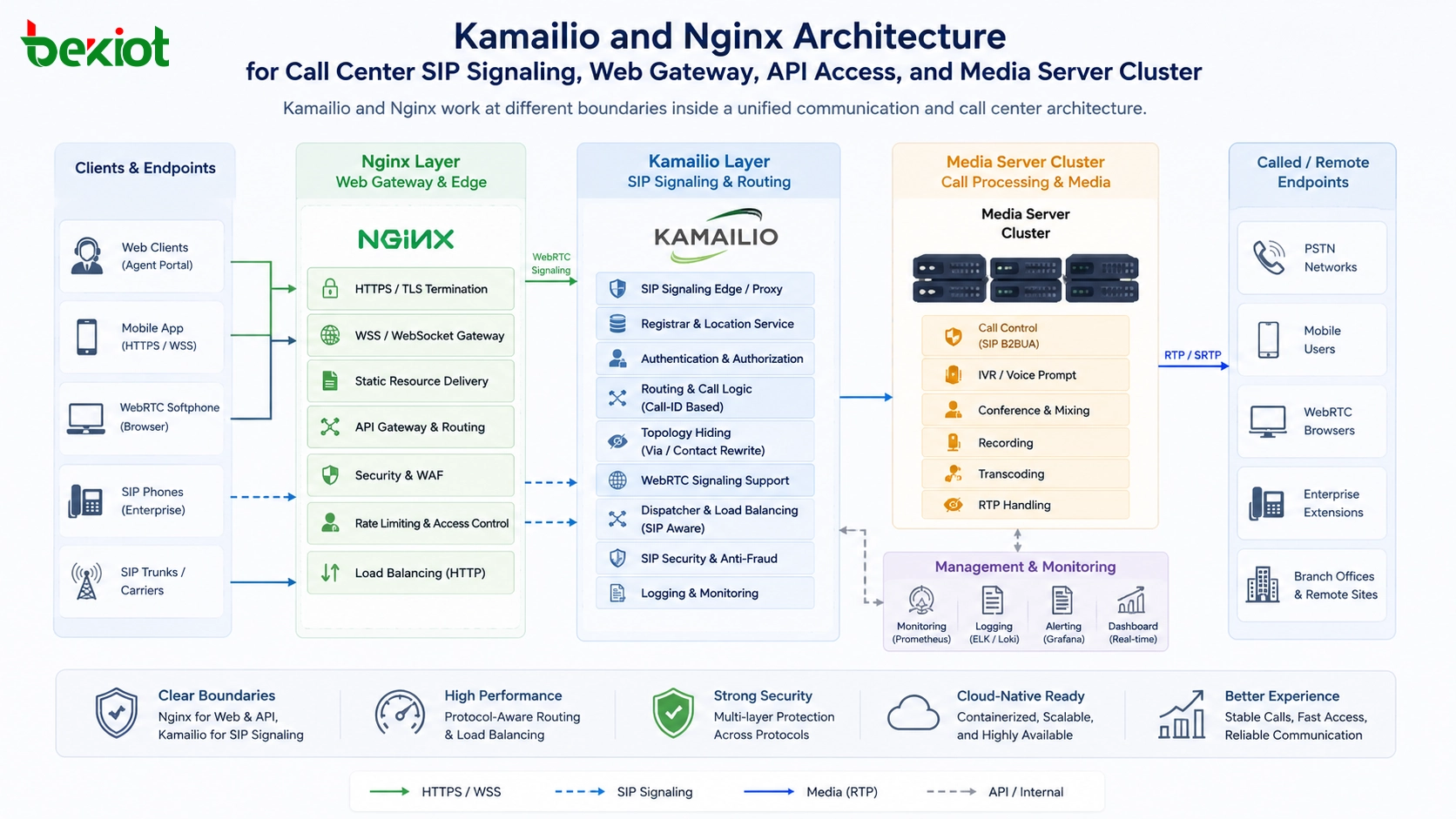
In many serious deployments, the most scalable answer is a hybrid architecture. A signaling-focused layer such as Kamailio or OpenSIPS may sit at the edge, handling registration, routing, load balancing, and traffic normalization. Behind it, Asterisk may deliver PBX logic and enterprise telephony services, or FreeSWITCH may provide conferencing and media-centric application behavior. This layered model reduces role conflict and lets each platform do what it is best at.

Such architectures are common because they align with real operational boundaries. The edge layer handles SIP policy and distribution. The service layer handles telephony features or media execution. Database and provisioning layers remain separate again. Instead of forcing one tool to be everything, the system becomes easier to scale component by component.

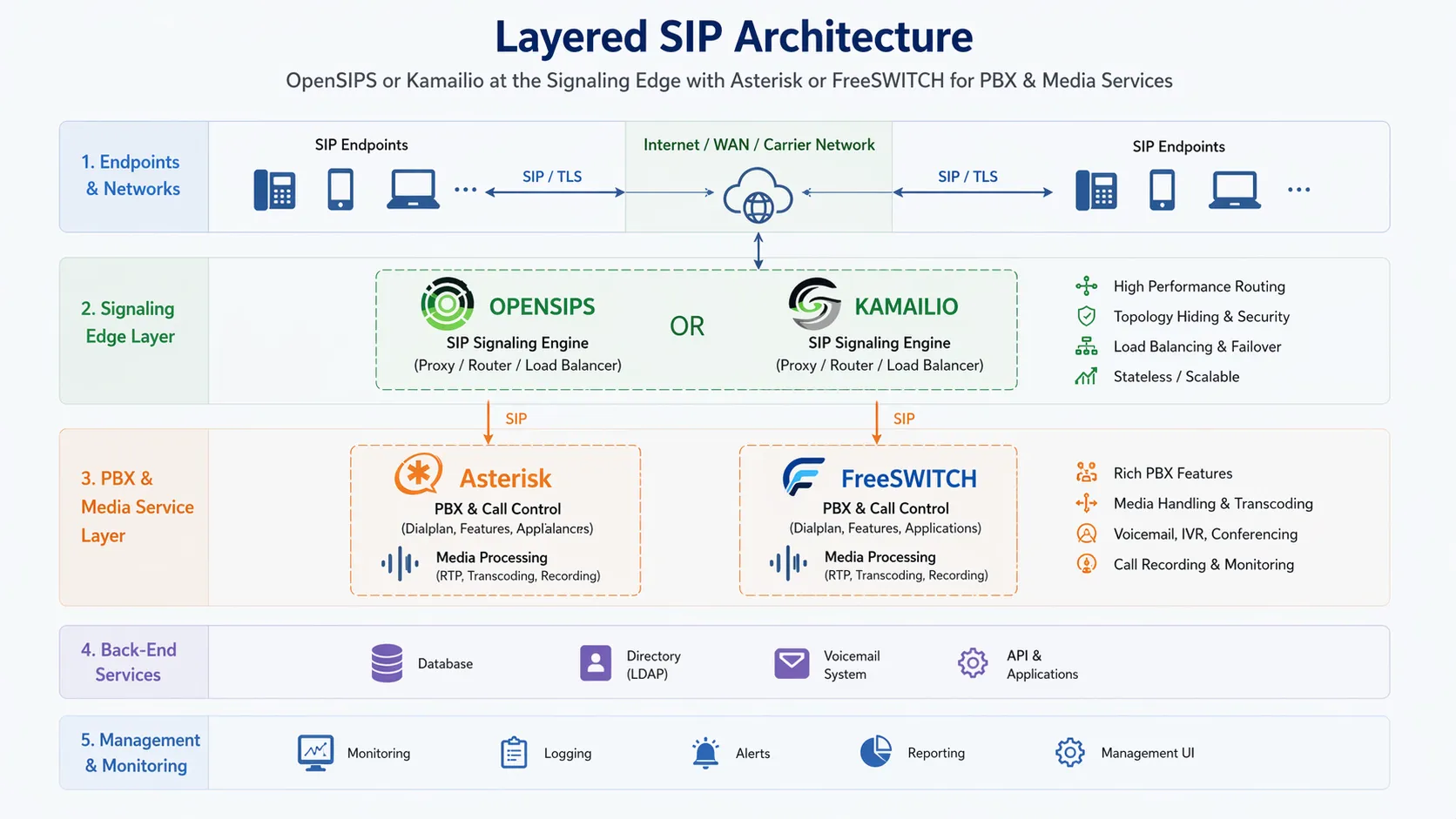
Layered SIP architecture showing OpenSIPS or Kamailio at the signaling edge with Asterisk or FreeSWITCH behind for PBX and media services
A layered deployment often scales better than an all-in-one node because signaling and service execution can grow independently.

Best-Fit Scenarios for Each Platform

When Kamailio is the better fit

Kamailio is a strong choice when the priority is high-performance SIP routing, registration handling, traffic dispatching, and policy control at the signaling edge. It fits well in service-provider style infrastructures, SIP trunk aggregation, large registration services, WebRTC-to-SIP style interconnection layers, and multi-node communication environments where downstream application servers need a disciplined signaling front end.

It is also a natural candidate when engineers want very fine control over routing behavior without turning the front-end node into a full telephony application server. In those cases, Kamailio’s value comes from efficiency, flexibility, and separation of concerns.

When OpenSIPS is the better fit

OpenSIPS is often attractive when teams want a carrier-grade SIP server with strong clustering narratives, high-throughput signaling, and flexible service composition. It fits multi-node SIP infrastructures, distributed registration services, large-scale ingress control, and custom SIP platforms that benefit from a modular, cluster-aware approach. It is especially compelling where scaling and distributed state handling are central design concerns.

For teams evaluating Kamailio versus OpenSIPS, the decision often comes down less to whether one can route SIP and more to project fit, scripting preference, module familiarity, ecosystem habits, and the specific operational model the team wants to adopt.

When Asterisk is the better fit

Asterisk is usually the better fit when the target outcome is a working PBX or communications application rather than only a signaling layer. Enterprise voice systems, internal office telephony, branch deployments, auto attendants, call queues, voicemail, simple conference use cases, IVR workflows, and custom telephony applications are all environments where Asterisk remains a highly practical choice.

It also makes sense for teams that want to build business telephony services quickly with mature call-control patterns and strong community familiarity. While it can certainly participate in larger architectures, its most intuitive value often appears where telephony behavior is central to the project.

When FreeSWITCH is the better fit

FreeSWITCH is especially compelling when conferencing, media control, programmable RTC behavior, and event-driven telecom applications are important. It is well suited to media-intensive systems, multi-party communication services, advanced conference environments, and scenarios where external applications need fine-grained interaction with the communications engine.

It can also be the right option when a project needs a versatile software telecom stack rather than a conventional office PBX focus. In those environments, its modularity and media-oriented design become major strengths.

How to Choose an Open Source SIP Server

The first selection criterion should be architectural role. If the project mainly needs SIP signaling, registration, routing, and front-end traffic control, start with Kamailio or OpenSIPS. If the project mainly needs telephony features, business call logic, and PBX behavior, Asterisk is often the more natural starting point. If the project revolves around conferencing, media services, or highly programmable event-driven communications, FreeSWITCH deserves close attention.

The second criterion is scaling strategy. Teams should ask whether the system is expected to scale mainly in signaling volume, in media or conference usage, or in feature-rich call application complexity. The third criterion is operational readiness. The right platform is the one the team can deploy, monitor, upgrade, troubleshoot, and extend consistently over time.

Finally, teams should resist the false choice between single-platform simplicity and multi-platform complexity. In many cases, the best answer is phased architecture. Start with the platform that matches the current bottleneck, then introduce layered separation as load, tenancy, geographic reach, or service diversity grows.

Conclusion

There is no universal winner in the open source SIP server landscape because these platforms are not competing for exactly the same job. Kamailio and OpenSIPS are especially strong as SIP signaling infrastructure. Asterisk remains highly effective as a PBX and communications application framework. FreeSWITCH continues to stand out for modular, media-centric, and event-driven communication services. The most reliable comparison is therefore not based on popularity or isolated benchmark claims, but on how well each platform matches the architectural role it is expected to perform.

In small environments, one platform may cover most requirements acceptably. In larger or more demanding environments, the most scalable and maintainable design is often layered. Signaling is handled at the edge by a proxy-oriented platform, while telephony features or media services run behind it on application-focused nodes. That approach creates a cleaner path to resilience, observability, and long-term growth.

FAQ

What is the difference between Kamailio and OpenSIPS?

Both are strongly associated with SIP signaling, routing, registration, and scalable edge behavior. In practice, the difference often comes down to clustering approach, scripting preference, module familiarity, ecosystem habits, and which operational model best fits the team. Neither should be reduced to a simplistic “better or worse” label without considering the deployment goals.

Is Asterisk a SIP server or a PBX?

Asterisk can speak SIP, but it is more accurately understood as a communications framework and PBX-oriented platform. Its value is not limited to SIP message handling. It is widely used for dialplan logic, IVR, queues, voicemail, gateways, and broader business telephony services.

Is FreeSWITCH better for conferencing?

FreeSWITCH is often a strong choice when conferencing and media control are major priorities. That does not automatically make it the right answer for every communication system, but it is frequently favored in projects where conference behavior, media programmability, and event-driven integration matter more than pure front-end SIP signaling efficiency.

Should I use one platform or combine several?

For smaller environments, one platform may be enough. For larger or more specialized deployments, combining a signaling-focused platform with a PBX or media platform is often the more scalable design. This lets each component stay focused on its strongest role.

Which open source SIP server scales best?

The honest answer is that scalability depends on what must scale. For signaling-heavy growth, Kamailio and OpenSIPS are often strong choices. For feature-rich PBX growth, Asterisk can be very effective when placed in the right architecture. For conference and media-centric growth, FreeSWITCH may be the stronger fit. The best-scaling system is usually the one whose responsibilities have been separated clearly from the start.

Recommended Products
catalogue
Professional industrial communication manufacturer, providing high reliability communication guarantee!
Cooperation Consultation
customer service Phone
We use cookie to improve your online experience. By continuing to browse this website, you agree to our use of cookie.

Cookies

This Cookie Policy explains how we use cookies and similar technologies when you access or use our website and related services. Please read this Policy together with our Terms and Conditions and Privacy Policy so that you understand how we collect, use, and protect information.

By continuing to access or use our Services, you acknowledge that cookies and similar technologies may be used as described in this Policy, subject to applicable law and your available choices.

Updates to This Cookie Policy

We may revise this Cookie Policy from time to time to reflect changes in legal requirements, technology, or our business practices. When we make updates, the revised version will be posted on this page and will become effective from the date of publication unless otherwise required by law.

Where required, we will provide additional notice or request your consent before applying material changes that affect your rights or choices.

What Are Cookies?

Cookies are small text files placed on your device when you visit a website or interact with certain online content. They help websites recognize your browser or device, remember your preferences, support essential functionality, and improve the overall user experience.

In this Cookie Policy, the term “cookies” also includes similar technologies such as pixels, tags, web beacons, and other tracking tools that perform comparable functions.

Why We Use Cookies

We use cookies to help our website function properly, remember user preferences, enhance website performance, understand how visitors interact with our pages, and support security, analytics, and marketing activities where permitted by law.

We use cookies to keep our website functional, secure, efficient, and more relevant to your browsing experience.

Categories of Cookies We Use

Strictly Necessary Cookies

These cookies are essential for the operation of the website and cannot be disabled in our systems where they are required to provide the service you request. They are typically set in response to actions such as setting privacy preferences, signing in, or submitting forms.

Without these cookies, certain parts of the website may not function correctly.

Functional Cookies

Functional cookies enable enhanced features and personalization, such as remembering your preferences, language settings, or previously selected options. These cookies may be set by us or by third-party providers whose services are integrated into our website.

If you disable these cookies, some services or features may not work as intended.

Performance and Analytics Cookies

These cookies help us understand how visitors use our website by collecting information such as traffic sources, page visits, navigation behavior, and general interaction patterns. In many cases, this information is aggregated and does not directly identify individual users.

We use this information to improve website performance, usability, and content relevance.

Targeting and Advertising Cookies

These cookies may be placed by our advertising or marketing partners to help deliver more relevant ads and measure the effectiveness of campaigns. They may use information about your browsing activity across different websites and services to build a profile of your interests.

These cookies generally do not store directly identifying personal information, but they may identify your browser or device.

First-Party and Third-Party Cookies

Some cookies are set directly by our website and are referred to as first-party cookies. Other cookies are set by third-party services, such as analytics providers, embedded content providers, or advertising partners, and are referred to as third-party cookies.

Third-party providers may use their own cookies in accordance with their own privacy and cookie policies.

Information Collected Through Cookies

Depending on the type of cookie used, the information collected may include browser type, device type, IP address, referring website, pages viewed, time spent on pages, clickstream behavior, and general usage patterns.

This information helps us maintain the website, improve performance, enhance security, and provide a better user experience.

Your Cookie Choices

You can control or disable cookies through your browser settings and, where available, through our cookie consent or preference management tools. Depending on your location, you may also have the right to accept or reject certain categories of cookies, especially those used for analytics, personalization, or advertising purposes.

Please note that blocking or deleting certain cookies may affect the availability, functionality, or performance of some parts of the website.

Restricting cookies may limit certain features and reduce the quality of your experience on the website.

Cookies in Mobile Applications

Where our mobile applications use cookie-like technologies, they are generally limited to those required for core functionality, security, and service delivery. Disabling these essential technologies may affect the normal operation of the application.

We do not use essential mobile application cookies to store unnecessary personal information.

How to Manage Cookies

Most web browsers allow you to manage cookies through browser settings. You can usually choose to block, delete, or receive alerts before cookies are stored. Because browser controls vary, please refer to your browser provider’s support documentation for details on how to manage cookie settings.

Contact Us

If you have any questions about this Cookie Policy or our use of cookies and similar technologies, please contact us at support@becke.cc .