touchpoint

In addition to terminal devices, all personnel, places, and things connected to the network should also be considered.

View Details

resource

Understand best practices, explore innovative solutions, and establish connections with other partners throughout the Baker community.

×

touchpoint

touchpoint

In addition to terminal devices, all personnel, places, and things connected to the network should also be considered.

Learn more

resource

resource

Understand best practices, explore innovative solutions, and establish connections with other partners throughout the Baker community.

Contact Us

Power plants, nuclear facilities, metallurgy sites, and mining operations require more than a basic broadcast system. These industries operate across large and complex areas, often under harsh environmental conditions such as high noise, dust, heat, humidity, vibration, corrosion, and restricted-access zones. Daily operation depends on timely communication between control rooms, production units, maintenance teams, and field personnel. When an abnormal event occurs, the same site must also be able to issue alarm notifications, evacuation guidance, and live instructions with speed and clarity.

A professional PAGA system combines public address, paging, and general alarm into one unified industrial communication platform. It helps operators deliver routine production announcements, zoned paging messages, emergency warnings, and evacuation instructions across wide industrial areas. In power, nuclear, metallurgy, and mining projects, this type of system plays an important role in both daily plant operation and emergency response readiness.

Becke Telcom provides industrial communication solutions for harsh and high-risk environments. For power generation, nuclear plants, metallurgy facilities, and mining operations, the solution can integrate PAGA, industrial telephones, emergency intercom, SIP communication, dispatch coordination, and third-party alarm linkage into a reliable and scalable industrial safety communication network.

Industrial PAGA system overview showing central control room, distributed horn speakers, emergency communication terminals, and plant-wide alarm coverage across power, metallurgy, and mining areas
A unified industrial PAGA architecture connects control centers, production areas, emergency communication terminals, and alarm broadcast devices across complex plant environments.

Why These Industries Need an Industrial PAGA System

Power, nuclear, metallurgy, and mining environments share several communication challenges. Sites are often large, functionally segmented, and continuously operating. Operators must communicate across turbine halls, boiler zones, substations, cable tunnels, conveyors, smelting shops, casting areas, shafts, underground passages, beneficiation plants, and central control rooms. Ordinary announcement systems are usually not designed for this level of complexity, environmental pressure, or emergency importance.

In routine operation, the system may be used for shift-change notices, maintenance coordination, area safety reminders, process alerts, and production instructions. In emergency conditions, it must quickly deliver high-priority messages related to fire, gas leakage, equipment failure, restricted access, evacuation, or process abnormality. These events require a communication platform that is not only audible, but also well organized, zoned, monitored, and integrated with the wider safety infrastructure.

  • Large industrial areas with multiple functional zones
  • High ambient noise in production and processing sections
  • Harsh environmental exposure such as dust, heat, humidity, and vibration
  • Continuous operation that requires high system availability
  • Need for routine production broadcasting and emergency alarm in one platform
  • Requirement for integration with plant safety, control, and communication systems
In high-risk industrial environments, a missed instruction or delayed alarm can affect not only production continuity, but also personnel safety and emergency response effectiveness.

System Positioning in Industrial Safety Communication

The PAGA system serves as a centralized voice communication platform for routine operation and emergency handling. It supports plant-wide or area-based broadcasting, live paging from the control room, general alarm activation, emergency voice messages, and coordinated communication across key production and utility areas.

In modern industrial projects, the PAGA platform is typically part of a larger safety communication framework. It may work together with industrial telephones, emergency intercom terminals, CCTV, fire alarm systems, gas detection systems, DCS, SCADA, PLC-based controls, and plant dispatch software. This gives operators a more coordinated way to manage both normal operation and abnormal events.

Core Components of the Solution

Central Control Platform

The central control platform manages zone definitions, audio routing, broadcast priorities, alarm logic, event records, and system supervision. It is generally installed in the main control room, central operation center, or plant dispatch room. For critical industries, the control platform can be designed with redundancy to improve availability and reduce the impact of single-point failure.

Paging Consoles and Operator Workstations

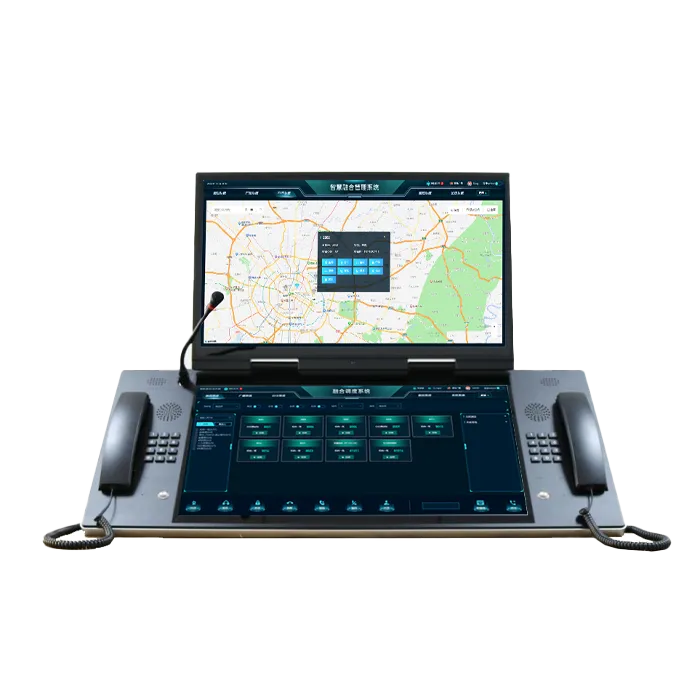
Paging consoles allow operators to make live announcements to selected zones or to the full site. These terminals support daily production coordination, maintenance notification, and real-time emergency voice control. Workstations may also provide monitoring, event logging, and access to system configuration and alarm status.

Industrial Amplifiers and Speaker Network

Industrial amplifiers and distributed loudspeakers form the audio output layer of the system. Depending on the site environment, the project may use horn speakers, wall-mounted speakers, column speakers, or special industrial-grade or explosion-proof loudspeakers in designated areas. The goal is to maintain strong audibility and practical speech clarity in difficult acoustic environments.

Emergency Communication Terminals

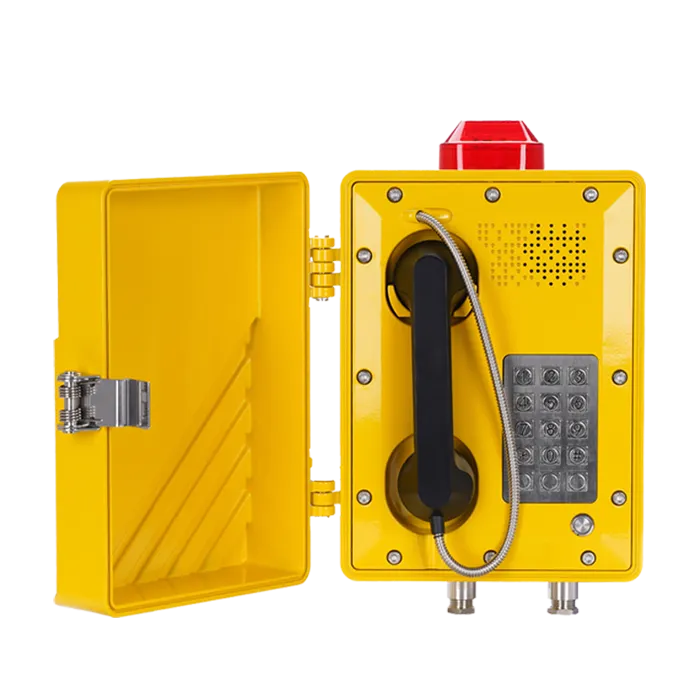
The solution can include industrial telephones, emergency intercom points, or SIP communication terminals in production zones, utility rooms, service corridors, underground passages, and restricted work areas. These devices complement plant-wide broadcasting by supporting direct communication between the field and the control center.

Recording and Management Modules

The recording subsystem stores announcements, paging events, alarm activity, and selected operator actions for later review. This supports operational tracing, incident analysis, training, and compliance documentation.

Interface and Integration Modules

Interface modules connect the PAGA platform with plant safety and control systems such as fire alarm, gas detection, DCS, SCADA, CCTV, SIP platforms, and dispatch systems. This integration improves response speed and helps communication follow real industrial events instead of operating independently.

ComponentMain RoleTypical Deployment
Central Control PlatformZone control, broadcast scheduling, alarm logic, system supervisionMain control room, central operation center
Paging ConsoleLive announcements, zoned paging, emergency voice commandOperator desk, dispatch room, control workstation
Industrial Amplifier and Speaker NetworkRoutine broadcasting, warning output, evacuation messagingProduction areas, workshops, tunnels, corridors, substations
Emergency Communication TerminalDirect voice communication and incident reportingField areas, utility zones, underground routes, restricted spaces
Interface ModuleIntegration with fire alarm, gas detection, CCTV, DCS, and telephonySystem layer, equipment room, control platform

Key Functions of the PAGA System

Routine Public Address

The system supports daily operational broadcasting across industrial sites. Typical uses include shift-change notices, maintenance schedules, work coordination messages, safety reminders, plant notices, and area-based instructions. This helps operators maintain better communication discipline across large and complex facilities.

Zoned Paging

Industrial plants often need precise area-based communication rather than site-wide broadcasting. The system can define and manage different zones so that operators can page only the relevant area without disturbing unrelated production sections. This improves message accuracy and reduces unnecessary interruption.

Typical zones may include:

  • Main control room
  • Turbine hall
  • Boiler area
  • Coal handling corridor
  • Substation and switchyard
  • Blast furnace area
  • Rolling mill
  • Casting workshop
  • Mine entrance and shaft station
  • Underground tunnel and processing plant

General Alarm

When a critical incident occurs, the PAGA system can trigger a general alarm across the whole site or selected zones. This may be used for fire, hazardous gas release, major equipment failure, access restriction, evacuation order, process abnormality, or other safety-related events. General alarm functions are especially important in facilities where immediate, plant-wide awareness is essential.

Emergency Voice Broadcasting

The system supports both pre-recorded emergency messages and live announcements. Pre-recorded messages help deliver fast and consistent instructions, while live paging allows operators to provide situation-specific guidance. Common emergency messages include evacuation instructions, hazard warnings, area isolation notices, incident alerts, and emergency response coordination.

Live Paging from the Control Center

Operators in the control room or dispatch center can issue live announcements to one zone, multiple zones, or the full site. This function is essential when the situation changes quickly and requires manual intervention, such as directing maintenance teams, informing field personnel about evolving hazards, or supporting emergency response decisions.

Priority Management

The solution can assign priority levels to routine broadcasts, live paging, intercom requests, and emergency alarms. High-priority alarm or evacuation content automatically overrides lower-priority routine audio, helping ensure that urgent information is delivered without delay.

Recording and Playback

Recorded announcements and alarm events support post-incident analysis, operational auditing, and training. Playback functions also help plant managers review whether messages were delivered correctly and whether response procedures were followed as intended.

Fault Monitoring and Status Supervision

The system can supervise amplifiers, speaker circuits, network links, key terminals, and other important nodes. This improves maintenance efficiency and helps identify faults before they compromise emergency communication readiness.

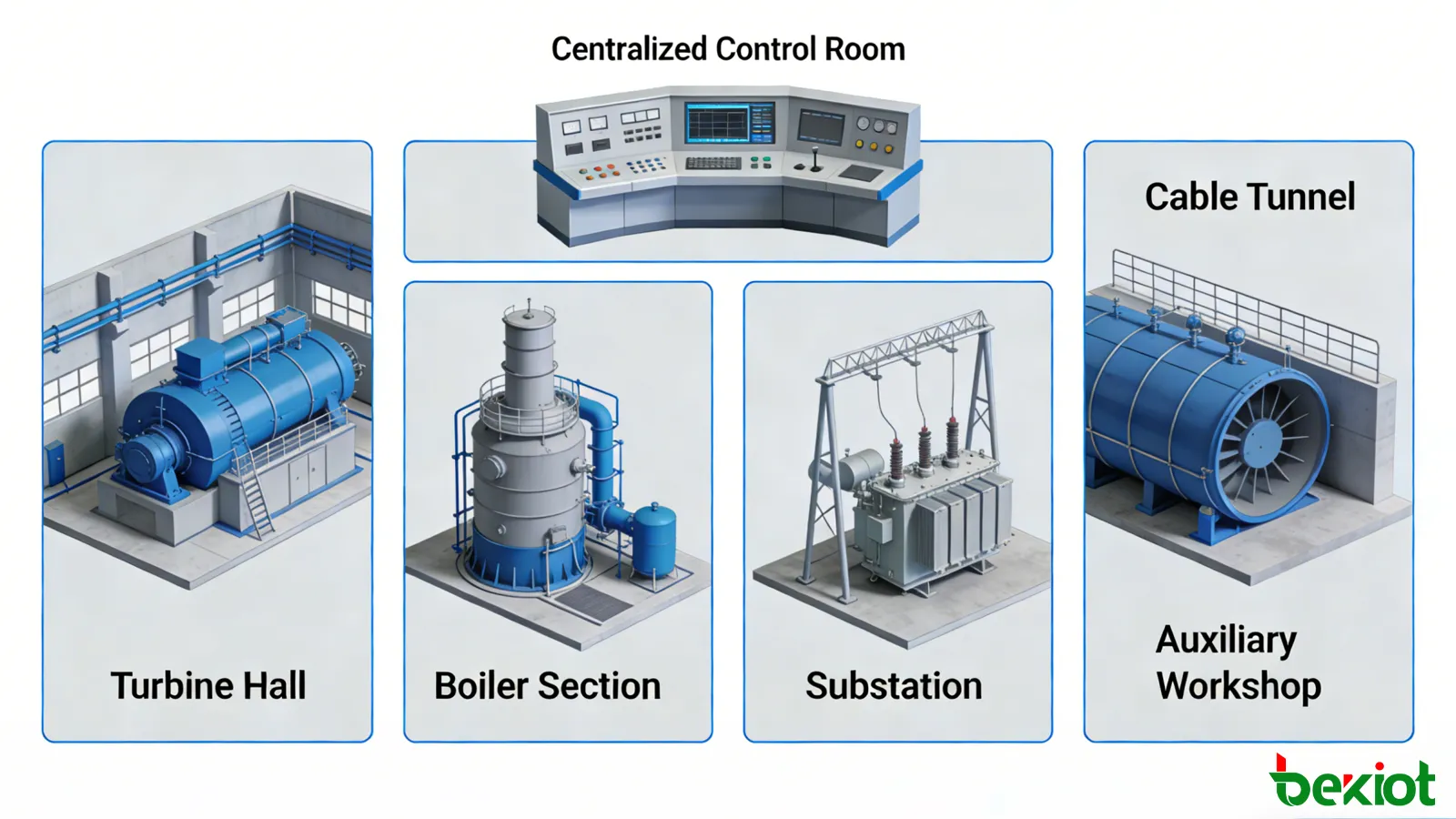
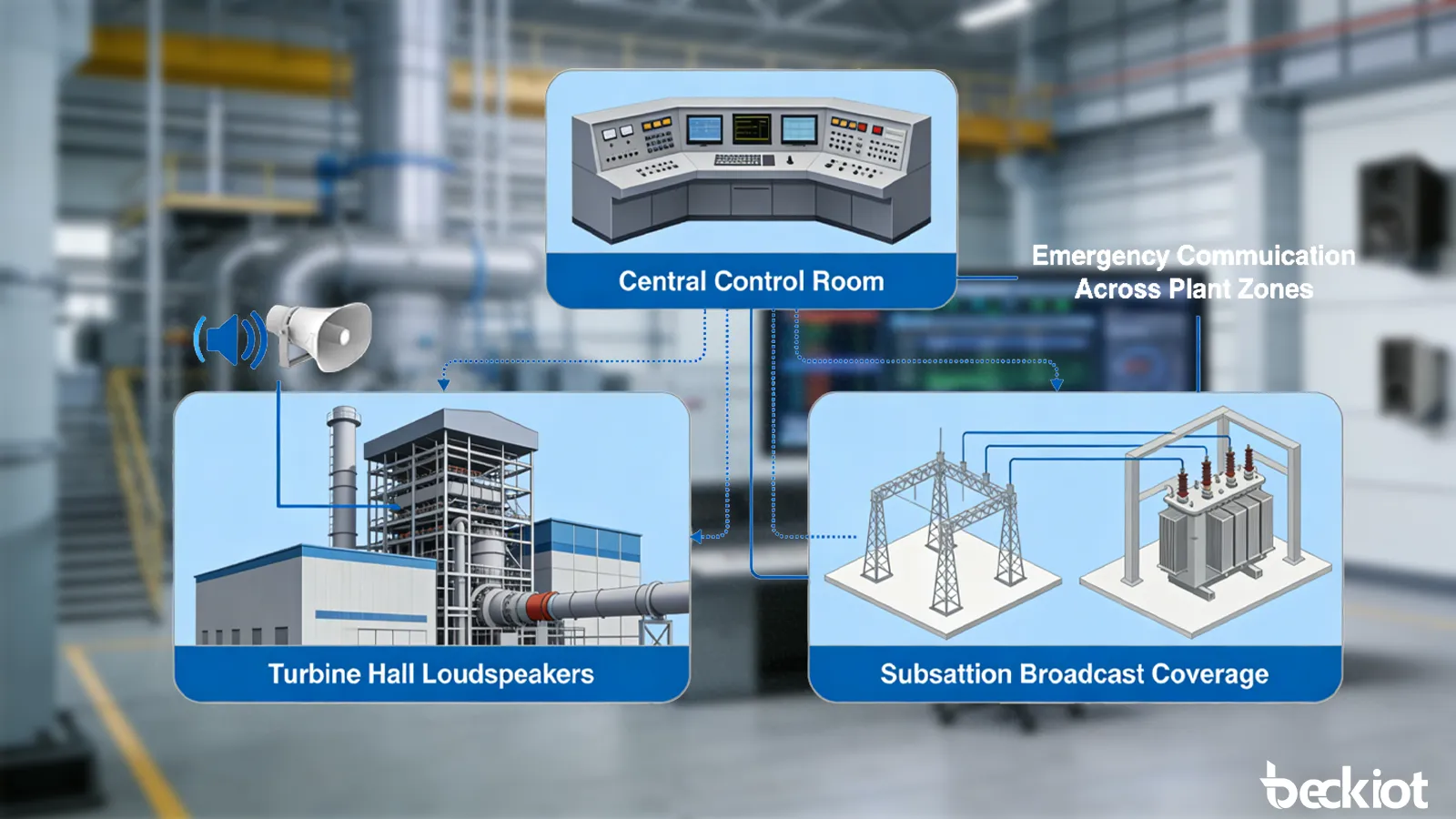
Industrial plant zoned paging across turbine hall, substation, boiler area, smelting workshop, underground tunnel, and processing plant with centralized control room management
Zoned paging allows industrial operators to deliver precise announcements to the correct production area while maintaining better communication control across the full site.

Typical Deployment Areas

Deployment planning should follow actual plant layout, process risk, noise level, personnel activity, and emergency route design. In these industries, communication coverage must extend beyond office buildings and include production and utility spaces where operational coordination and emergency response are most critical.

Power Industry

Typical deployment areas include the main control room, turbine hall, boiler section, coal handling area, cable tunnel, switchyard, substation, auxiliary workshop, and emergency assembly points. These zones need both routine communication and rapid emergency voice coverage.

Nuclear Facilities

Deployment may cover the main plant area, turbine building, auxiliary building, maintenance sections, technical corridors, control room, and designated emergency assembly areas. These facilities require disciplined and reliable communication support for both operational control and safety procedures.

Metallurgy Sites

Common zones include blast furnace areas, converter shops, rolling mills, casting areas, raw material yards, power distribution rooms, and control centers. These environments often require high-output audio and strong resistance to industrial conditions.

Mining Operations

Typical deployment areas include the mine entrance, shaft station, underground tunnels, refuge chamber areas, conveyor roadways, crusher stations, beneficiation plants, and dispatch centers. In mining projects, the communication solution must support long-distance coverage, difficult environments, and coordinated emergency guidance.

Industry AreaMain Communication NeedRecommended System Role
Turbine Hall / Boiler AreaProduction coordination, safety notices, emergency alarmRoutine public address and high-priority warning
Substation / SwitchyardOperational instructions and fault-related notificationsZoned paging and alarm communication
Smelting / Rolling / Casting AreaArea-based announcements in high-noise environmentsIndustrial speaker coverage and live paging
Mine Entrance / Shaft / Underground TunnelEmergency guidance, help access, workforce coordinationZoned paging, alarm broadcast, linked emergency communication
Processing Plant / Conveyor CorridorMaintenance communication, hazard notice, operational messagesDistributed broadcast and area supervision
Control Room / Dispatch CenterCentralized command and response coordinationPaging console, monitoring, event management

Typical System Integration

The practical value of an industrial PAGA system increases significantly when it is linked with other plant systems. Instead of working as an isolated broadcast tool, the solution becomes part of a coordinated industrial safety communication framework.

  • Fire alarm integration: emergency messages can be triggered automatically when fire-related events occur
  • Gas detection integration: hazardous gas alarms can activate zone-based warnings and evacuation guidance
  • CCTV integration: operators can verify events visually while making announcements or dispatch decisions
  • DCS or SCADA integration: process events and plant alarms can be linked to communication actions
  • SIP telephony integration: routine voice communication and broadcast management can work within a wider voice network
  • Dispatch system integration: plant-wide incident response and team coordination become more structured and efficient

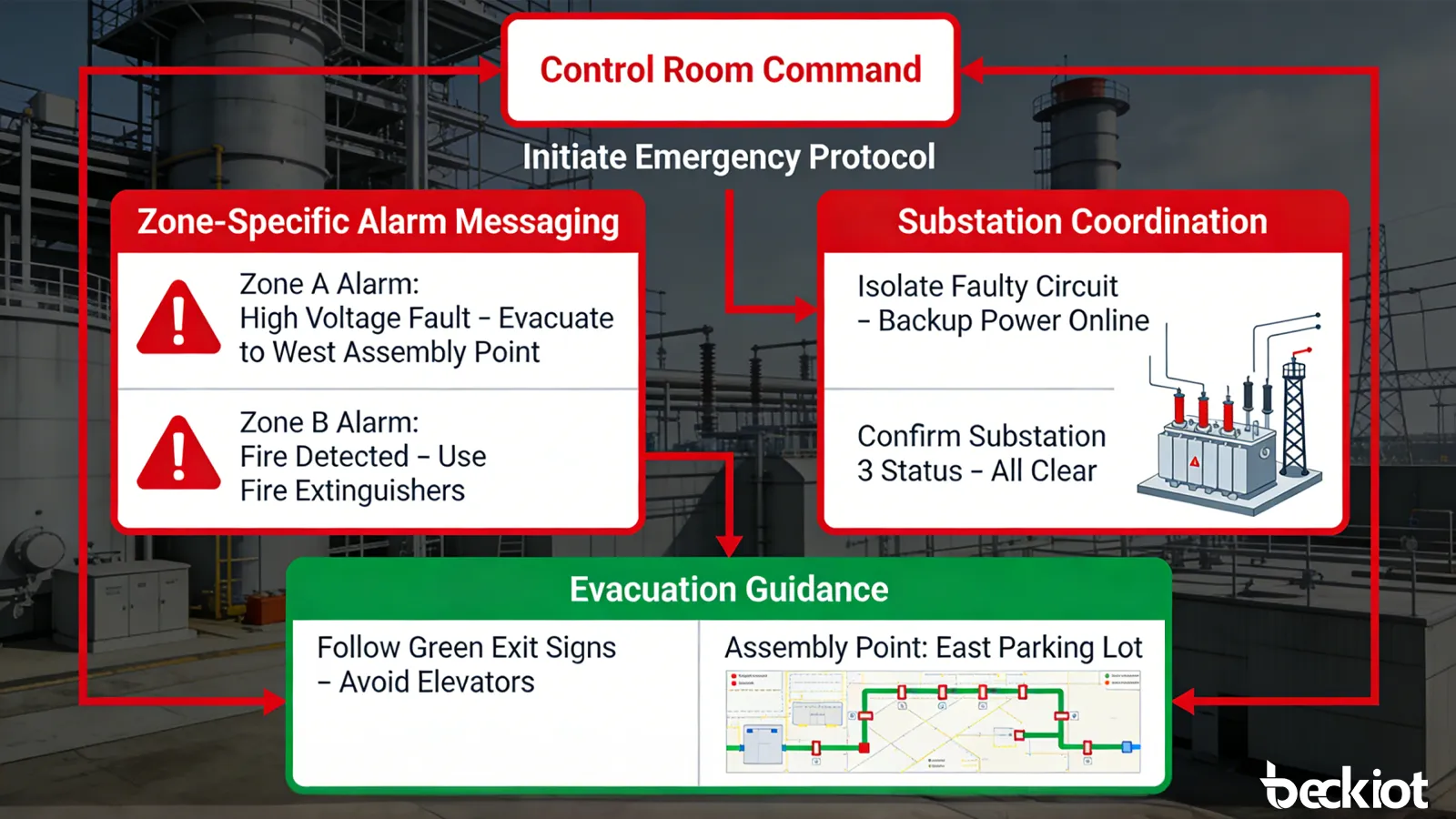
For example, if a gas detection system identifies a leak in a designated process zone, the PAGA platform can automatically issue a warning to that area, notify the control room, and allow operators to broadcast live evacuation guidance to affected personnel. This kind of system linkage reduces delay and improves clarity in time-sensitive industrial events.

Emergency industrial broadcast and alarm response across mining tunnels, processing zones, and control center with linked gas detection and evacuation guidance
Integrated alarm linkage helps industrial operators combine event detection, emergency voice warning, and control-room coordination into one faster response process.

Design Considerations for Harsh and High-Risk Industrial Projects

Speech Intelligibility in High-Noise Areas

In turbine halls, metallurgical workshops, conveyor galleries, and underground mine sections, speech clarity matters more than raw sound level alone. The system should be designed for practical intelligibility under real operating noise conditions.

Harsh Environment Adaptation

Industrial devices may be exposed to dust, heat, moisture, corrosion, vibration, and wide temperature changes. Equipment selection should therefore reflect environmental suitability as well as communication performance.

Wide-Area Coverage with Zoned Control

These industries often involve large and segmented sites. The communication platform should support broad area coverage while also allowing flexible zone control for accurate message delivery.

High Reliability and Redundancy

Critical industries require strong system availability. Redundant architecture for control hosts, network transmission, power supply, and amplifier paths can help reduce operational risk.

Fast Emergency Response

The solution should support automatic alarm triggering, rapid message playback, and live operator takeover when conditions change. This is especially important where incident response speed affects plant safety and personnel evacuation.

Open Integration Capability

The PAGA platform should integrate smoothly with existing plant systems to avoid information silos and improve coordination between control, safety, and communication layers.

A strong industrial PAGA solution is not just about broadcasting sound. It is about giving operators a reliable way to inform, warn, guide, and coordinate people across the most demanding industrial environments.

How Becke Telcom Supports Industrial PAGA Projects

Becke Telcom focuses on communication solutions for harsh and high-risk applications. In power, nuclear, metallurgy, and mining projects, its PAGA solution is designed to support both routine plant operation and emergency communication through a unified and scalable architecture.

The solution can integrate public address, general alarm, industrial telephony, emergency intercom, SIP communication, distributed speaker systems, and plant dispatch functions into one manageable communication framework. This helps industrial operators reduce fragmentation, improve communication efficiency, and strengthen emergency readiness across key production and operational zones.

  • Unified architecture for public address, alarm, intercom, telephony, and dispatch
  • Flexible zone-based communication for complex industrial sites
  • Integration support for fire alarm, gas detection, CCTV, DCS, and SCADA
  • Reliable communication design for harsh industrial environments
  • Scalable deployment for power plants, nuclear facilities, metallurgy sites, and mining operations

Practical Value of the Solution

For plant owners, EPC contractors, industrial operators, and system integrators, a professional PAGA solution delivers value in both daily operation and emergency management.

  • Improves communication efficiency across large and complex industrial areas
  • Supports unified management of routine broadcasting and emergency alarm
  • Enhances response speed during incidents and evacuation scenarios
  • Strengthens coordination between control centers and field teams
  • Reduces communication delay, confusion, and missed instructions
  • Supports safer, more controlled, and more manageable industrial operation

Conclusion

PAGA solutions for power, nuclear, metallurgy, and mining are an essential part of modern industrial safety communication. In environments where noise, distance, risk level, and operating continuity all influence communication performance, a unified platform for public address, paging, and general alarm provides a more reliable way to support both routine work and emergency response.

By combining routine broadcasting, zoned paging, general alarm, live voice command, and system integration into one architecture, industrial operators can improve coordination, strengthen safety procedures, and build a communication framework better suited to harsh and high-risk environments. This is a practical foundation for safer operation, faster response, and stronger industrial communication management.

FAQ

What is a PAGA system in industrial environments?

It is an integrated communication system that combines public address, paging, and general alarm to support routine broadcasting, area-based voice communication, and emergency warning across industrial facilities.

Why is zoned paging important in power, metallurgy, and mining sites?

Zoned paging allows operators to deliver messages only to the relevant area, which improves accuracy and avoids disturbing unrelated production sections.

Can the system be used for emergency evacuation?

Yes. The solution can issue evacuation instructions through pre-recorded messages or live operator broadcasting, depending on the incident and plant procedure.

Can this solution integrate with industrial control and safety systems?

Yes. It can be integrated with fire alarm, gas detection, CCTV, DCS, SCADA, SIP telephony, and dispatch systems to support more coordinated industrial communication and response.

Professional industrial communication manufacturer, providing high reliability communication guarantee!
Cooperation Consultation
customer service Phone
We use cookie to improve your online experience. By continuing to browse this website, you agree to our use of cookie.

Cookies

This Cookie Policy explains how we use cookies and similar technologies when you access or use our website and related services. Please read this Policy together with our Terms and Conditions and Privacy Policy so that you understand how we collect, use, and protect information.

By continuing to access or use our Services, you acknowledge that cookies and similar technologies may be used as described in this Policy, subject to applicable law and your available choices.

Updates to This Cookie Policy

We may revise this Cookie Policy from time to time to reflect changes in legal requirements, technology, or our business practices. When we make updates, the revised version will be posted on this page and will become effective from the date of publication unless otherwise required by law.

Where required, we will provide additional notice or request your consent before applying material changes that affect your rights or choices.

What Are Cookies?

Cookies are small text files placed on your device when you visit a website or interact with certain online content. They help websites recognize your browser or device, remember your preferences, support essential functionality, and improve the overall user experience.

In this Cookie Policy, the term “cookies” also includes similar technologies such as pixels, tags, web beacons, and other tracking tools that perform comparable functions.

Why We Use Cookies

We use cookies to help our website function properly, remember user preferences, enhance website performance, understand how visitors interact with our pages, and support security, analytics, and marketing activities where permitted by law.

We use cookies to keep our website functional, secure, efficient, and more relevant to your browsing experience.

Categories of Cookies We Use

Strictly Necessary Cookies

These cookies are essential for the operation of the website and cannot be disabled in our systems where they are required to provide the service you request. They are typically set in response to actions such as setting privacy preferences, signing in, or submitting forms.

Without these cookies, certain parts of the website may not function correctly.

Functional Cookies

Functional cookies enable enhanced features and personalization, such as remembering your preferences, language settings, or previously selected options. These cookies may be set by us or by third-party providers whose services are integrated into our website.

If you disable these cookies, some services or features may not work as intended.

Performance and Analytics Cookies

These cookies help us understand how visitors use our website by collecting information such as traffic sources, page visits, navigation behavior, and general interaction patterns. In many cases, this information is aggregated and does not directly identify individual users.

We use this information to improve website performance, usability, and content relevance.

Targeting and Advertising Cookies

These cookies may be placed by our advertising or marketing partners to help deliver more relevant ads and measure the effectiveness of campaigns. They may use information about your browsing activity across different websites and services to build a profile of your interests.

These cookies generally do not store directly identifying personal information, but they may identify your browser or device.

First-Party and Third-Party Cookies

Some cookies are set directly by our website and are referred to as first-party cookies. Other cookies are set by third-party services, such as analytics providers, embedded content providers, or advertising partners, and are referred to as third-party cookies.

Third-party providers may use their own cookies in accordance with their own privacy and cookie policies.

Information Collected Through Cookies

Depending on the type of cookie used, the information collected may include browser type, device type, IP address, referring website, pages viewed, time spent on pages, clickstream behavior, and general usage patterns.

This information helps us maintain the website, improve performance, enhance security, and provide a better user experience.

Your Cookie Choices

You can control or disable cookies through your browser settings and, where available, through our cookie consent or preference management tools. Depending on your location, you may also have the right to accept or reject certain categories of cookies, especially those used for analytics, personalization, or advertising purposes.

Please note that blocking or deleting certain cookies may affect the availability, functionality, or performance of some parts of the website.

Restricting cookies may limit certain features and reduce the quality of your experience on the website.

Cookies in Mobile Applications

Where our mobile applications use cookie-like technologies, they are generally limited to those required for core functionality, security, and service delivery. Disabling these essential technologies may affect the normal operation of the application.

We do not use essential mobile application cookies to store unnecessary personal information.

How to Manage Cookies

Most web browsers allow you to manage cookies through browser settings. You can usually choose to block, delete, or receive alerts before cookies are stored. Because browser controls vary, please refer to your browser provider’s support documentation for details on how to manage cookie settings.

Contact Us

If you have any questions about this Cookie Policy or our use of cookies and similar technologies, please contact us at support@becke.cc .